
Last weekend I rented a van with my pal and drove from London to Eryri National Park (Snowdonia) with our tickets for the Pan Celtic Gravel Rally in our pockets. This meant a 19km ‘night stage’ on the evening of the Friday, starting at 2030, and the 136km ‘long’ route the next day starting at 0830. The gravel rally is a bit like an enduro event, where participants race through ‘timed sectors,’ separated by untimed rally. This would be my first off-road endurance event and this blog post is a short round up of the two things I got right and that I got wrong. Hopefully you can learn from it and your own rides will be smoother sailing!
If you’re anything like me you’ll be most curious about the errors so that’s what’s up first.
Flop 1: Don’t underestimate Wales
I’d taken the upcoming event very seriously, and had trained for it, but I quickly found that a 90km off road ride around my home neighbourhood tracks and trails just didn’t cut it against the terrain in Eryri. I ended up doing a lot of walking on this ride. What made it easier for me was I was using my Voodoo Bizango hardtail MTB, fitted with 780mm wide enduro bars, which are a lot easier to push up a hill than narrower drop bars. I didn’t envy those puffing away on 400mm curly bars at all. I saw quite a few people picking up their bikes and carrying them in frustration because the curly bars make it tricky to navigate a loaded bike up and over rocks and roots.
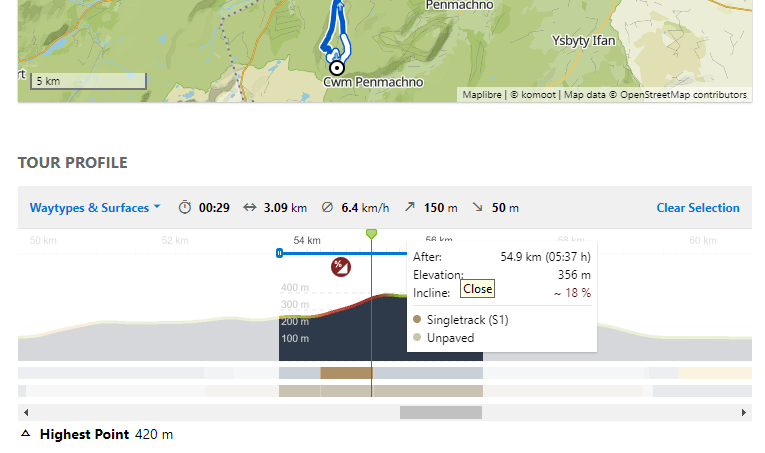
Approximately 2 hours in to my ride, I decided to switch to the ‘short’ route (which is 95km long). The organisers of the race are catering for some of the strongest riders in the world, including world tour team members, and I had no problem with accepting that I wasn’t among their ranks. Fortunately I’d loaded both the long and short routes on to my wahoo roam navigation unit so it was very simple to boot the new route up. If you’re ever doing an event like this, I’d recommend keeping all of the routes on you, just to give flexibility.
As for gears, I would have benefited from lower ones. My hardtail had a 32t chainring, and the lowest sprocket (11 speed) was 42. Which while definitely good enough for my riding around Surrey and Epping Forest, would have been improved either by swapping for a smaller chainring or a wider cassette. Though wide cassettes are expensive, and a small chainring can leave you spinning on road sections and downhills.

Flop 2: A disastrous mechanical – but could have been much worse
The gears on the MTB began getting a bit ‘slippy’, with me needing to ‘ghost shift’ the rear mech in order to find a desired gear which wouldn’t jump. In short this often means going ‘up two down one’ (or vice versa). This got worse later in the ride, as the chain began dropping off the lowest (biggest) sprocket and getting stuck between the freehub body and spokes.
I think this was caused by a combo of the mech hanger getting bent and badly set limit screws. My attitude at the time was that trying to rectify this on the trail would be liable to cause more problems than it solved (My SRAM GX rear mech confused me with which limit screw was which), so I resolved to just try to not shift ‘too far.’ This bit me in the bum approximately 15 km from the finish line as the derailleur was dragged in to my spokes, snapping the chain, twisting the derailleur and grinding me to a halt.
I’d dealt with snapped chains and problems like this before, so while I wasn’t thrilled the situation, I resisted panic and pulled over, got my chain tool out and prepared to split off the snapped bits. But placing the tool over the chain, aligning it with the bit I wanted to trim off and twisting, I found the chain’s pin wasn’t coming out. Checking, I found the chain splitter on the multi tool was bent. So I was stuck.
Thankfully a very kind person called Adam pulled over and lent me his own chain tool. Without it it would have been a long long walk to the finish line, so I’m very much in their debt. The one thing I’m a little annoyed about is that this happened on a timed sector, which did spoil my results a bit, but them’s the breaks.
While I could get the chain off and repaired, the next issue was that the rear derailleur hanger was badly bent, with the derailleur twisting off in an awkward angle, not allowing the chain to engage with the cassette. I just had to put my hand on the mech and twist it to a vaguely sensible position, and just like that, I was now single-speeding.


The lesson I learned from this is that it’s all well and good packing your tools and spares, but you do need to ensure that they’re in good condition. I’ve bought a chain tool online (not a multi tool) and will keep it in the on-bike toolkit from this point on to keep this from happening again. As for the derailleur, it’s a write-off, so just swapping the hanger (which I carry a spare of) would have been pointless. I’m going to take care of that when the new derailleur arrives in the post.
Win 1: I got the food and drink right
I’ve already had my share of rides where you’ve run out of food and drink. Reviewing the route ahead of time, resupply looked very very thin on the ground, so I packed heavy. One of my best wins on this ride was using a large Alpkit hip pack. This meant that food was very accessible without needing to park the bike anywhere and reach inside any bags, and because the bag was so spacious, I had enough to keep me going all the way around. I’d bought it from a friend and this was by far the best new bit of gear I could have had on me. I also had room to attach a small first aid kit to its waist belt. While cycling I barely noticed it was there.

For water, this was a bit harder. My solution was to just have one drinking bottle, but a 2 litre ‘top up’ bottle in my saddlebag. This turned out to be enough for the ride (with a top-up at the midway stop). I did notice that I seemed to be carrying more than most people, and saw quite a few people drinking from streams. Everyone has their own risk tolerances for stuff like this but for me, the risk of there being a dead sheep upstream or some other hazard means I’ll avoid doing it as much as I can. If I had more money I’d definitely consider using a water filter so that I could continuously add more to my ‘top up’ bottle. I was fortunate that it was a mild and cloudy day which limited how much I felt I needed to drink.
Speaking of sheep, I try to only use water bottles that have a sealed lid. As you ride a bike (both on-road and off), filth and muck will be sprayed on you and your bike as you ride, and that includes on whatever you’re drinking from. It’s been found by scientists that dangerous pathogens can get in to or on to drinking bottles while cycling, including e-coli, often from livestock manure. So my bottle of choice, from decathlon, has a hinged lid that keeps the actual drinking bit clean from contamination. I’m glad to report that my tummy has been fine ever since the ride.
Win 2: I definitely had the right bike
I’ve already gone on about why I think a hardtail mountain bike is the way to go for off-road riding in the UK, but there are a few extra reasons I found myself thankful I was using such a bike for this event.
The first is that because of the geometry, the MTB had a lot more room for the dropper post to drop me down during descents. I saw quite a few riders on gravel bikes lose control of their bikes, with them being unable to get their weights low and far back enough to stay in control on more technical downhills. Of course gravel bikes can be specced with dropper posts, but the typical seatpost diameter is 27.2mm which makes finding one that’s compatible expensive, and to get the most out of a dropper post, you want a heavily sloping top tube that means your saddle has further down to go. Even though I had a ‘giant saddlebag’ on, because of the mudguard on the back of the bike, it never got in the way of getting nice and low down.
The wide bars, which I’ve mentioned already, helped keep my bike steady even on shingly stuff, and though my hardtail ‘only’ has 2-piston brake calipers, they did a great job with making me feel safe and in control.

My tyres and wheels also performed really well. I had a Vittoria Saguaro on the back and a Maxxis Ardent on the front, both set up tubelessly, and I’d made sure to top the sealant up before the trip. The grip from both was great and I had no flats. I saw quite a few people who’d punctured even with tubeless tyres, and had given up trying to reseal the holes, instead undergoing a mucky putting-of-a-tube-in. I’ve written up my own learnings about tubeless tyres before and I stand by them completely.
I’m very glad that I’d put new pads in for the event, and also swapped my front rotor to a new one. While I’d gone to two shops who thought the front rotor looked within tolerance, I erred on the side of caution and I’m glad I did, because the descents in Wales were long, steep, and fast.

Future plans
This was a fantastic event, I had a few hiccups and there’s a lot to learn from but I absolutely will be back in 2025. I’d highly highly recommend getting on the waiting list for the next Pan Celtic Gravel Rally by tracking the website and I’ll see you up there next year.

 Calum On Wheels
One thought on “2 flops and 2 wins at the Pan Celtic Gravel Rally 2024”