
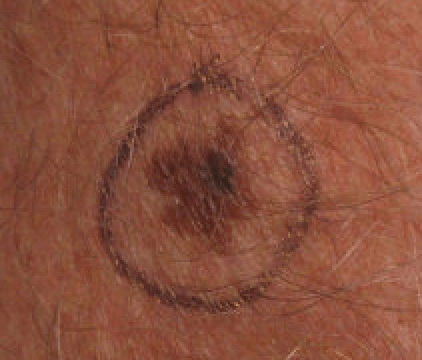
A long while ago, I had a company car and a decent monthly take-home payslip, which let me start scuba diving in the UK, which I’d dreamed of doing since I turned old enough to read Willard Price adventure novels. A core memory from my time as a diver was reading a ‘letter of the month’ sent to the British Sub-Aqua Club’s monthly magazine, where a contributor shared a photo taken of them clambering back on board a boat, fresh from a dive. In a close-up box, was circled a mole behind their ear which they’d never have seen. The diver was extremely lucky in that they were in a club with a practising doctor, who told them to immediately go and get it checked for melanoma. It turned out that they’d contracted skin cancer, and given that the mole was behind the ear and out of their sight, the likelihood is they’d never have seen it as it grew worse, and eventually, the cancer would have spread to the other organs of the body, by which point it is likely to become untreatable.
Since reading this letter I’ve worn sunscreen/suncream/’SPF’ every day. But I’ve found that cheaper suncreams can be really difficult to live with if you’re doing cycling on a sports basis, especially off road. So this is an article about how I’ve made the best of it and the solutions I’ve arrived at. Hopefully it helps keep you safe.
Fundamentally the only surefire way to stay safe from skin cancer is to stay out of the sun, and suncream/sunscreen/SPF should be taken as a chances-improver, not a total guarantee of safety. For a better rundown of skin cancer prevention you should defer to the likes of Cancer Research UK, this article is only about how I’ve found 3 different SPF products and which I’d recommend for cycling purposes.
Cheaper suncreams; why they can be hard to live with
Firstly, the obvious solution to staying safe from skin cancer is to cover as much skin as you can and stay out of direct sun. This is not easily done if you want to keep enjoying your cycling when it’s warm – and some premium sports fabrics are actually so skimpy that they don’t protect the skin underneath. Famously, in 2014, then-Team Sky rider Chris Froome was badly burned all over the upper body with only the parts under his jersey covered by his heartrate monitor and team radio protected from UV rays.
The obvious solution is to err on the side of thicker fabrics (in my experience, fabrics used in clothes sold by the likes of Decathlon and Planet X are ok). And for exposed areas, specifically your hands, legs, arms, head and neck, to slap on suncream. From what I’ve found online, the cheapest reputable factor 30 (which I understand as the minimum acceptable protection factor as per Cancer Research UK) is sold by Asda as ‘ASDA Protect Moisturising Sun Lotion SPF 30 High.’
From what I’ve read, cheaper suncreams (sold by reputable retailers) are effective at protecting from UV. However, as a cyclist, I would advise not plumbing for the cheapest, because they tend to pick up dirt and grease from the road or the trail very well. I especially remember during my 600k ride a few years ago, during which I was using Sainsbury’s own-brand SPF 30, that I could scrape my skin with a credit card, and a gross layer of dirty grease would come off with it. Also, sweat can run down your face, mix in with the grease above the eyes, and then leak in on to your eyeballs giving you the dreaded ‘blockout’, which at best is deeply annoying and at worst makes you completely blind. So while cheap SPF is great for many people as a ‘daily driver,’ I’ll share how I’ve found 3 products have been pretty good for me while cycling and how they measure up against each other. All of them are grease-free, keep your skin feeling dry, and are resistant against blockout.

Riemann P20; my favourite, but not cheap at £13.20/100 ml shipped (or £9.50/100 ml with Costco)

According to its manufacturer, P20 was invented in 1979. They claim to have improved the formula in the time since. P20, in various ‘strengths,’ comes out of its tubes or sprays as a yellowish gel which rubs in to the skin and doesn’t leave much behind on the surface. It has a vaguely alcoholish smell which doesn’t hang around.
Some people claim that ‘you don’t need to use that much of it’ but I much prefer to apply it in the same volume as any other spf product. That is to say, generously.
Firstly, the good. P20 is the closest I think it comes to a SPF product that you genuinely don’t know is there. Even the factor 50 version doesn’t leave any kind of grease on the skin to catch dirt or clog up the pores. If I were a rich person I would have P20 by the bucket.
The downsides are that it is undeniably an expensive product. Compared to e.g. Asda’s factor 30 mentioned earlier, which at the time of writing is £1.40/100 ml, P20’s factor 30 equivalent is £13.20/100 ml (on Amazon), making it nearly 10 times dearer. The best deal I’ve found is via Costco (£18.99/200 ml) but that requires having a Costco card. I’m also not a fan of its form factor (container). P20 is packaged in opaque white cylinders which can make tracking how much is left a bit difficult. I do wish it were available in a larger bottle, but unfortunately the sunscreens in this article all top out at 200 ml. So while I wish I could wear P20 every day, it really does punish the bank balance which left me looking elsewhere.
Pelotan; pretty good so long as you don’t mind coconut. £8.25/100 ml shipped (with Cycling UK 25% discount code, in 3x bottles of 200 ml)

I got a Pelotan bundle after winning a free Cycling UK prize draw, upon which they sent me a bundle of a 200 ml spray bottle, a 100 ml bottle of the same, and a 50 ml roll-on bottle. To date I’ve not spent a penny on Pelotan but was pretty impressed with it throughout the weeks I wore it. It felt very similar to Riemann, in the sense that it has a non-greasy finish and didn’t feel ‘cloggy’ on long rides, but the key difference was that it does have quite a strong coconut scent, which many of my colleagues at work picked up on.
Pelotan is also sold in a ‘roll on’ form which I don’t much like. Firstly because I find getting an idea of how much product I’m putting on difficult to figure out, but also it just seems like pointlessly adding more plastic junk to the landfill than is really necessary. The spray bottles themselves are OK, but like Riemann, are opaque so you just have to figure out how much is left by feel.
The killer feature that Pelotan has is that, combined with a membership discount code you get via Cycling UK, it is about £5 cheaper per 100 ml than P20 while having nearly all the same benefits. The most cost-effective way I’ve found is by adding three 200 ml spray bottles to the cart on their own website (which is enough for free shipping), and then applying the Cycling UK discount code for 25% off.
I wasn’t able to find a UVA rating for Pelotan. My guess is that this signifies it probably rates below 5 out of 5, but that’s all that is, a guess.
NIVEA SUN Protect & Dry Touch; my new daily driver, £5.50/100 ml (shipped, from Boots)
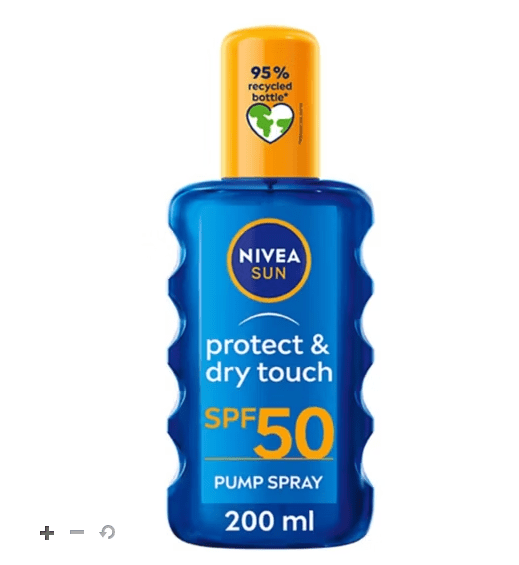
I forget when I came across dry touch but I was searching terms like ‘dry sunscreen’ or ‘no grease sun screen’ when I found it in May 2024. I think it’s not been around for too long, though my online searches aren’t coming up with an exact date of when it was launched.
The killer feature of the dry touch is that it is significantly cheaper than the other two I’ve used. That probably means you’ll use more of it, which is only a good thing. It’s available in SPF 30 and 50, I’ve bought it in 50 just as it’s currently June and it seems prudent to up the SPF for the summer, and the grease-free finish and non-cloggy-ness are good. I have been wearing this stuff all day for just over a month now and I’m very impressed. As a bonus, the bottle is translucent, so tracking how much is left is very easy.
Of course the big feature of this product is that it’s £5.50/100 ml, when ordered as 3×200 ml bottles from Boots. This is significantly cheaper than the other two on this list. The downside is that it’s rated as 4 out of 5 UVA protection stars, versus Riemann’s 5 out of 5 (and, not to forget, Pelotan doesn’t have a UVA rating at all).
Final thoughts
It is disheartening how expensive these SPF products are. There is campaigning to remove VAT from sun protection products, on the basis that they are crucial to human health, which would certainly take some of the wince out of buying them. Even the cheapest on this list is twice the per-100 ml cost of Famous Grouse whisky which is obviously subject to VAT and the relevant alcohol duties.
It would be great to be able to get refillable SPF products from the likes of shops like Harvest. However I can see how this would be problematic, because they do have a shelf life (note, none of the bottles in this article print an expiry date) and it is important for the companies to be able to give a definite ‘use by’ date for specific batches of the stuff they make.
Regardless of whatever you end up buying, I do hope that you take your safety from the sun seriously. When it comes to the final calculation, even P20, on a cost-per-day basis, is still much cheaper than eg a daily oat flat white. I’ll be using the Nivea for the remainder of the summer and will reexamine the market for future options once I’m nearing the running-out point.
In the meantime please get your facts on sun protection from Cancer Research UK and stay safe!
 Calum On Wheels
