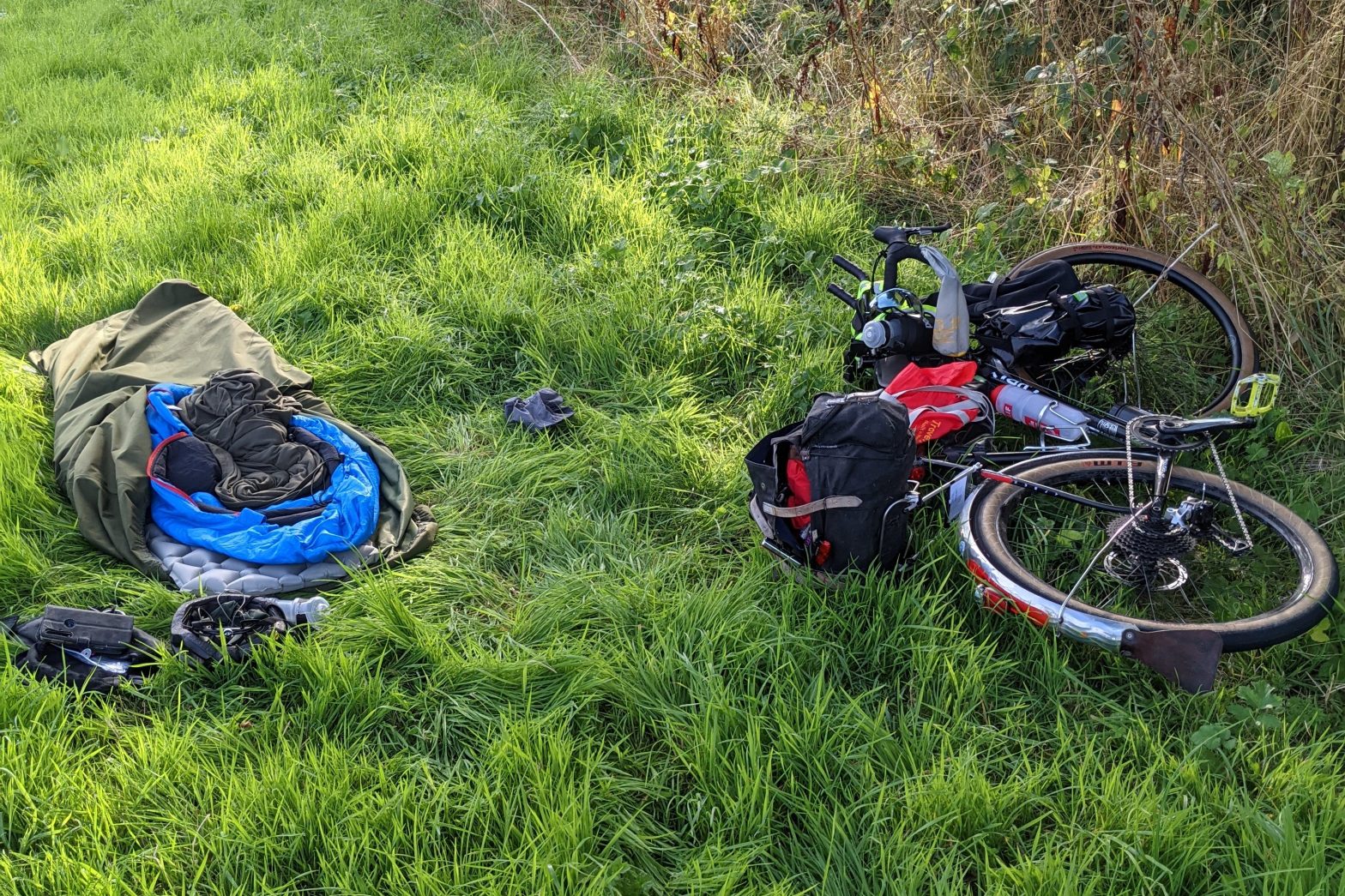
One of the earliest problems any would-be bikepacker has to contend with is which sleeping system is the best. If you’re like me, you don’t have infinite money and storage space to keep stuff in (or to book glamping huts), so you end up picking a compromise solution that hopefully covers all your bases. I’ve had my army surplus bivvy bag for a few years now and it’s one of my favourite things. Supposedly in the military they’re known as the ‘green time machines’ since once you’ve clambered inside, you’ll instantly fall asleep and you’re back on duty before you know it. This is a blog post about why that is and hopefully it sways you to check out this cheap and robust item of gear.
What is bivvying and why do it?
A bivvy bag (from the French ‘bivouac’ – some people spell it as ‘bivi’) is, in essence, a weather resistant outer sleeping bag. Some products marketed as bivvy bags do include poles and pegs, especially ‘hooped’ bivvies, but the simplest ones like mine are just big sacks, usually with some kind of hood at the end where your head is. One lays it the bag out, climbs in, and that’s all there is to it.
Bivvying is very robust, because in fair conditions, you can use just the bag, and enjoy a pleasant night under the stars. An unobstructed view of the sky at night is a rare treat for me as a city dweller. It always seems a shame to me to make all the effort to sleep outdoors and miss out on the night sky by sleeping under a cover when not necessary.

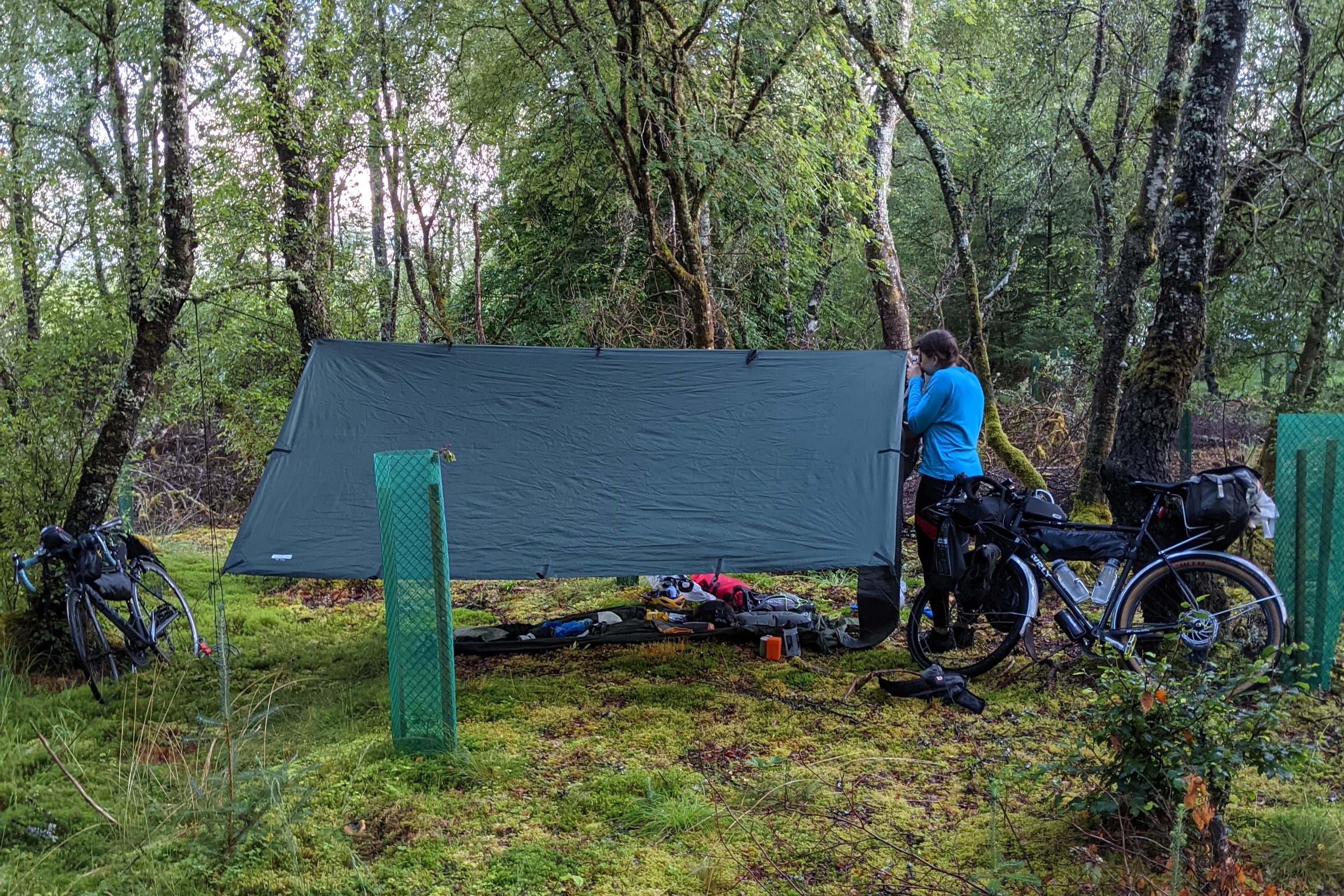
Mostly, though, I’ll ride with a tarp. I typically carry a DD 3×3 metre tarp which I can hang up above the campsite, affording good protection from rain, while enabling me and a friend to cook and socialise in open air and a view of our surroundings but with the benefit of a roof. There is no carbon monoxide risk when cooking with a stove under a tarp, unlike when in a tent. The tarp needn’t be a technical material and my DD one folds up very compactly, easily fitting in a small bag on one of my fork’s adventure cages.
What makes this army bag so great?
Here’s a very brief history: in 1948, after the second world war, the USSR tried to annex all of Berlin, which was split in to east and west, by sieging the western part in what was known as the Berlin blockade. An intense air supply effort by the western allies meant that the USSR eventually gave up trying to starve west Berlin into surrender. Shortly after, NATO, the North Atlantic Treaty Organisation, was formed by the western powers opposed to the USSR, and an effort was made to establish a commonality of military supplies so that resources could be more easily shared during the many decades that followed, known as the ‘Cold War.’ One such standardised item was this bivvy bag, so while they may vary in colour and some design details, many countries actually had bivvy bags made from the same material and to broadly the same dimensions and specification, with some minor differences. Products made to this standard, from sleeping bags to socks to pots and pans, are widely available as army surplus, often bought by retailers to re-sell following the mass demobilisation of the Cold War armies following the dissolution of the USSR in 1991.
You’ll note the scare quotes around ‘gore tex’ in the headline. The bag (and other products made of similar materials) are commony called gore tex in the services, but strictly speaking, it’s a different fabric which has similar properties. Long story short, the fabric is foul weather resistant, but allows sweat to evaporate through the fabric, preventing the dreaded ‘bin bag effect’ that wearing non-breathable fabrics tends to produce. If you’re wondering what that means, poke your arms and head through a bin bag and do a 20 minute run, and you’ll notice that the sack will soon be soaking wet with your own perspiration. Strictly speaking, ‘gore tex’ is a brand owned by the company W. L. Gore & Associates, so in this instance, it’s just used as a shorthand for what should be more accurately termed ‘Moisture Vapour Permeability’ fabrics, or MVP.
While many companies such as Alpkit and Rab make and retail bivvy bags, I really favour my NATO one. The key advantages of bivvying in this bag over alternatives for me are:
Durability and simplicity.
It’s literally just a bag, there are no pegs to lose or poles to look after. It’s a very rough and ready system. In all likelihood if you get a surplus bag, it could be older than you are, and working as well as it did the day it was made. The fabric, which is comparable to ‘gore tex’ but more robust, is very resistant to damage, in my experience. You’ll need to use an inflatable mat to prevent losing body heat to the ground (and for a comfortable night’s sleep), which the bivvy bag does a good job in protecting from abrasion and thorns etc.
A little embarassingly I don’t think I’ve ever actually cleaned the bag. But if you ever needed to, some warm water and a sponge should about cover it for maintenance. MVP fabrics can be reproofed, either by yourself using a washing machine, or by a professional company, but my bag is holding firm despite being who-knows-how-old.
Cheap.
Army surplus sites tend to sell them for about £40, depending on the condition (brand new versus used). If you use ebay or facebook marketplace, even better deals will abound. I also like that these products should have a long life and stay out of the landfills forever, unless you really put it through the wringer in extreme conditions.

Ease of storage and drying.
Because the bag itself is weatherproof, you can roll it up and tie it down to something. In fact, you can put stuff inside it such as your sleeping bag to keep it dry while you’re on the move. Admittedly the bivvy bag itself is certainly not small, but this is not so much an issue when you account for how it doesn’t strictly need to be kept inside anything.
Spacious and baggy – it’s a feature, not a bug
Some other bivvy bags on the market make an effort to limit themselves in weight. In my opinion this is missing a trick, because a spacious (and necessarily heavier) bag has several advantages. Firstly, it means there’s more room for things you want to prevent getting cold and damp overnight, such as your shoes and the next day’s clothes. Secondly, some bivvy bags have issues with getting wet on the inside, because your sweat isn’t able to evaporate through the technical fabric of the bag. Because army bags are sized for a heavily set squaddie and their gear, there is more interior surface area for perspiration to evaporate through, which means for me there’s never been a problem with moisture on the inside of the bag.
In the case of there being any, you can just turn the bag inside out and swing it around the air a bit to dry it back out.
The army system is actually specced for conditions up to arctic use (the Cold War was a worldwide frozen conflict, from Korea to Mozambique), and you can source the arctic sleeping bag seperately. I wouldn’t recommend it for bikepacking, it’s thick synthetic down and while wonderfully warm, is a real nightmare to transport by bike. But that means you get to pick the mat and sleeping bag that fits your own requirements. I shan’t get in to sleeping bags and mats in this post for the purposes of brevity, but just to say that there is room inside the army bag for a highly wide range of insulation options, from light summer-weight bag liners to deep winter below-freezing conditions.
Why not just use a tent/hammock/tauntaun?
I’m certainly not anti-tent. I’ve borrowed one a few times for occasions when I’m making a longer stay in a place, such as at a cycling event, and especially when the ‘accommodation’ is an open field which doesn’t have anywhere convenient to hang a tarp or hide from inclement conditions. But I find that I really treasure the simplicity of the bag, and as I mention, I don’t have a lot of money and storage space, so the bag is where it’s at for me at the present.
Another option many people have told me to get in on is hammocking. I’m not saying ‘never’ with hammocking but a good system looks like it will come up to a couple of hundred quid. So maybe that will happen one day, but for time being, you’ll find me in the time machine.
Update; this post is now in kind-of podcast form!
As of 15 January 2026, there is now a CalumOnWheels podcast episode on this topic. Please do have a listen.
 Calum On Wheels
2 thoughts on “A bikepacking love letter to my army surplus “Gore-tex” bivvy bag”