
I’ve been carrying a compact first aid kit in a hip pack for a few years now. It comes with me while cycling and running, and when I’m out at work too. I’ve used it a few times and thought this short post about how first aid might be something you should think about more and prepare for. But more importantly I’ve done a variety of training which is honestly more important than just ‘having the gear.’ I’ve tried to condense this into a shortish article about my reflections on the topic, and hope it’s useful.
Disclaimer; nothing in this post is medical advice that you should depend on in any way that could get me in trouble. Always ring the emergency services when you think you’re in an emergency. It’s entirely me writing up my learnings and thoughts. That’s all! Oh and also this article contains photography of fake blood and simulated injuries which I will try to make as clear as I can. There is no real blood or real injuries in this post.
First aid; the thing the group riding, bikepacking and ultra racing guides often skip over
I often listen to things like the Dot Comms podcast in which various people from the cycling community chip in about what they’ve found useful and necessary in their travels. For sure, pointers like mechanical preparation, food and warmth are all valuable and important. But I often reflect on how first aid just doesn’t seem to much come up. You might well have had here-and-there first aid training, as I have, but I most seriously started getting up to date in April 2023, when a bunch of friends and I decided to get some kind of proper training. We’d noticed we’d often be leading cycle rides out of London, but with no formal training in what to do in the event of some kind of bump. Regrettably I’d been on some bike rides with other operations where someone had fallen off and no one really had any up to date training, or if they did, had no gear on their person. All we could do was cautiously ride somewhere warm and wait for an Uber. I’d also reflected on some of the emergencies I’d helped people with. Often the emergency itself wasn’t super grave, but the consequence, where you’d have to sit around for an hour or two in cold or wet conditions waiting for a taxi on account of your bike being busted, could be quite serious.
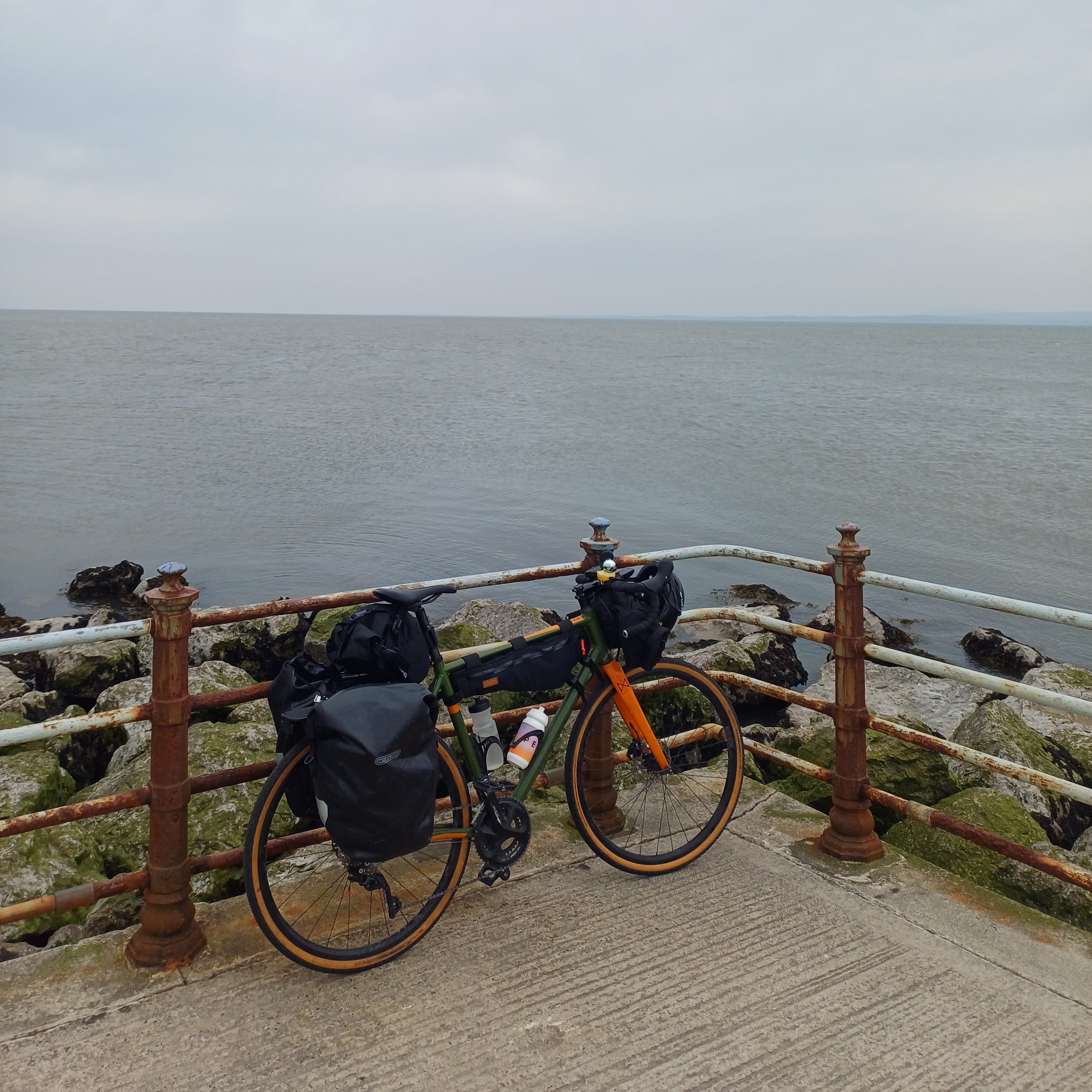
First aid training does a few things I think are very important. Firstly, it marks you out as someone who takes health and safety seriously. It is easy to forget that riding a bicycle is a risky and high speed activity. Something like a snapped chain on a steep climb, or a slip on a rocky descent, can land you in it very quickly, and you are not invincible. Secondly, being a first aid trained person makes you more knowledgeable concerning your own limits and safety needs especially in conditions like high heat, winds, and biting cold. I think there is a strong tendency for people to look at the weather conditions as something just there to be endured, and not a safety risk for yourself and others to be guarded against. It is only a bike ride. Your health and your safety and those of your friends are the priority. Lastly, I think it’s important to be mindful that if you plan on being a member of a group of cyclists, you could make a huge difference by having the skills and equipment to help control an emergency. First aid might not be the ‘curing the sick’ miracle everyone wants, but it could absolutely prevent infection and stop an injury from worsening, or maybe even save a life, who knows.
First aid training for cyclists: I think it’s best to start with a 1 day Emergency First Aid at Work course
When I first started looking at training, I wanted to book in for some sort of specialist ‘first aid for cyclists’ syllabus which would be aimed at helping people falling off bikes i.e. focused on road rash and minor grazes. But I quickly realised that probably the most expedient thing to do would be to sit a more generalist ‘Emergency First Aid at Work’ (EFAW) qualification. You can do one of these in a single day, in which you learn to treat the most widespread emergencies which you may well end up encountering on the bike or at work. For instance, it hadn’t occurred to me that choking is a genuine medical emergency and someone you’re out with riding with could choke on a bone going down the wrong airway, and could depend on your actions for their safety. Or how about if you cycle past someone who’s fallen and isn’t responding to people trying to rouse them from unconsciousness?
Because of this I’d highly encourage you to at the least seek out and pass an Emergency First Aid at Work class (this will accredit you to a level of training as set out in UK legislation), and is quite doable in the space of a day and doesn’t cost too much. The EFAW course is a set curriculum but your instructor can always help tailor it for your group’s needs. Doing training also includes real life simulated casualties (and yes, you will be a casualty for someone else in many instances too), which is highly effective for everyone’s learning, because in my view a huge element of first aid is seeing a situation and having the confidence that you can take control and act.
If you want to go further with your training then you absolutely can – the logical progression is the 3 day ‘First Aid at Work Course.’ This is at the least, one day of online pre-learning, and then two days of real life training. But EFAW is a great starting point for anyone and I’d highly encourage it, it’s even a nice way to spend a day with friends.
Carrying the gear; how much and where to keep it
It is amazing how much stuff you can cram in to a small first aid kit. The downside is that it doesn’t neatly unpack like a hard plastic case you might find in a car, or on a wall at work – when you unzip it, it can feel a bit untidy! – but it will fit very well in a water bottle holder like you might have on a bum bag/hip pack/fanny pack, whatever you want to call it. I take mine practically everywhere, and I’m sad to say I’ve used it more often than I’d like, but every time the people I’ve been with have been thankful that it was there.
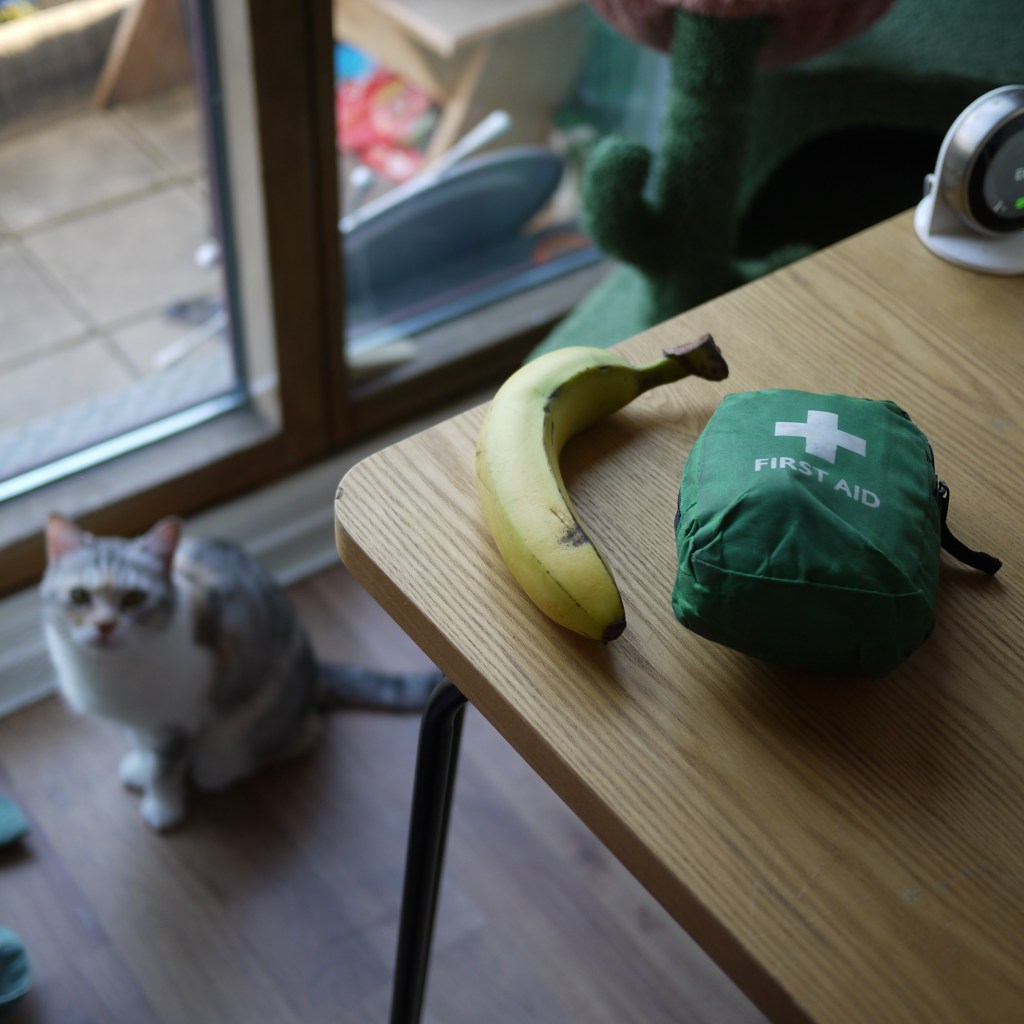
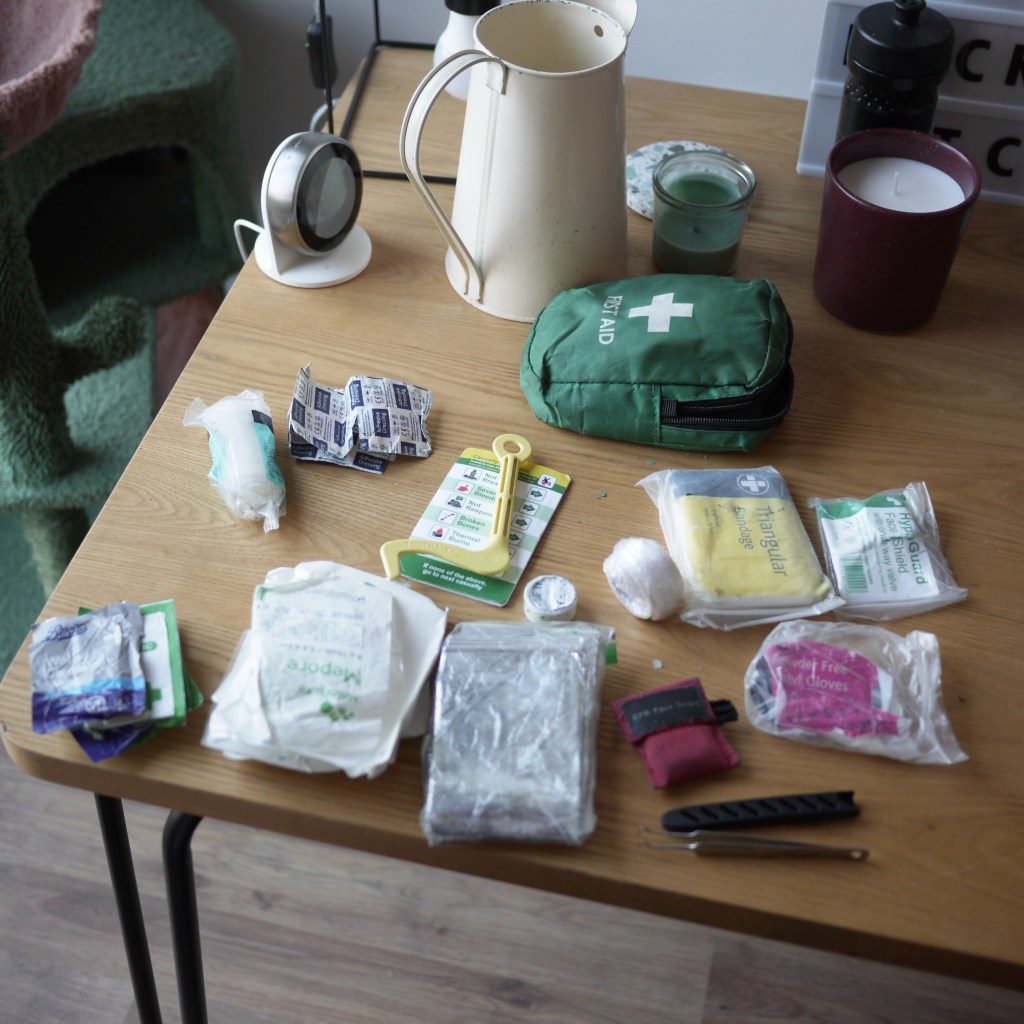
The actual kit I have is just a cheap one I got from Halfords. They tend to have a bit of spare room you can cram some other bits in. Reviewing your kit, I think it’s a good idea to reflect on what you’re really likely to use. I do have a CPR face mask and a valve, but I hope I never use these in my life. What I seem to get through the most is sanitary wipes, gloves (single use and individually packaged) and dressings. I also carry tick tweezers which have also been useful for wasp stings. Note that most gloves you get in e.g. Boots will be in a big box rather than individually packaged. It’s important to have clean wrapped gloves for your casualty’s safety, and your own (you don’t want bloodborne nasties getting into any cuts and grazes you may have on your own hands – bear in mind you might be a bit hurt yourself too).
Next most used is the thermal blanket. These are very cheap off ebay and pack down nicely into the first aid kit. But they’re a hugely underrated aspect of first aid. Firstly, someone who gets cold is likely to start acting irrationally and make bad decisions. And secondly, especially following some sort of trauma or injury, they can go in to shock. In this instance using a foil blanket as well as whatever other insulative materials you can find (dry cardboard is especially good as it can often be got out of bins), you can control a situation until help arrives. This is a good reminder for me to get another because I have given them away to people who are sat, injured, waiting for ambulances or taxis. Personally I don’t even leave the house without an extra synthetic down jacket layer on me between the months of September and May, either in the ‘giant saddlebag’ or around the belt fastening of my hip pack.
What I’ve next ended up using a lot of are wipes and dressings. I’ve found that it’s better to have dressings that are too big than too small, because you can always get a casualty to apply pressure to a wound themselves using a dressing that’s oversized. They’re very affordable from pound shops and are quite compact in the first aid kit, and another benefit of large dressings is they’re easy to get out from the first aid kit without them all spilling everywhere. Wipes are quite small and again are affordable from pound shops. Just buy a big box, keep it somewhere safe and top up your first aid kit when you need to.
Last but not least, I have a ‘tourne-key’ and a leaflet from St John Ambulance. The Tourne-Key is a plastic device that can be used in tandem with a bandage, but also any improvised tourniquet, in the event of a major bleed. It also comes with a handy guidance leaflet which can be used as an ‘anti pinch’ card which goes under the plastic tool so that you can make the tourniquet even tighter. Without an anti pinch card, your casualty may not be so cooperative because it will hurt a great deal more without one, though you can improvise using anything you judge appropriate such as a credit card, paper magazine and so on.
Having the gear and the training is one thing, but you will also need the skills and experience to act
Something I’m really fascinated with is people’s fight and flight reflex in high pressure situations. I teach ’emergency fixes’ for cyclists concerning their own bikes, and always start the class asking people to relate emergencies they’ve recovered from. It’s always the mental battle first that is the hardest. Someone might have the tools and spares and knowledge needed to recover a situation, but they need to steel themselves up if that’s to be of any use to them. Some of my tutees have shared their own methods for making this happen – getting warm, eating, and getting somewhere sheltered like a bus stop are among them – but also people share how they’ve been able to take some deep breaths and ovecome difficulty. In a first aid situation it can be very similar, and it could be made worse by your own personal injuries. You might have a casualty who resists you trying to help them, insisting they are fine (I have experienced this, and it is very scary). You might also have a casualty who completely gives up and just freezes, which could be as dangerous to them as it is you, especially if they fall off a bicycle in to the road where a driver could come blasting by and not see them. First aid training can help you prepare for these instances where theoretical knowledge and ‘having the gear’ isn’t enough.
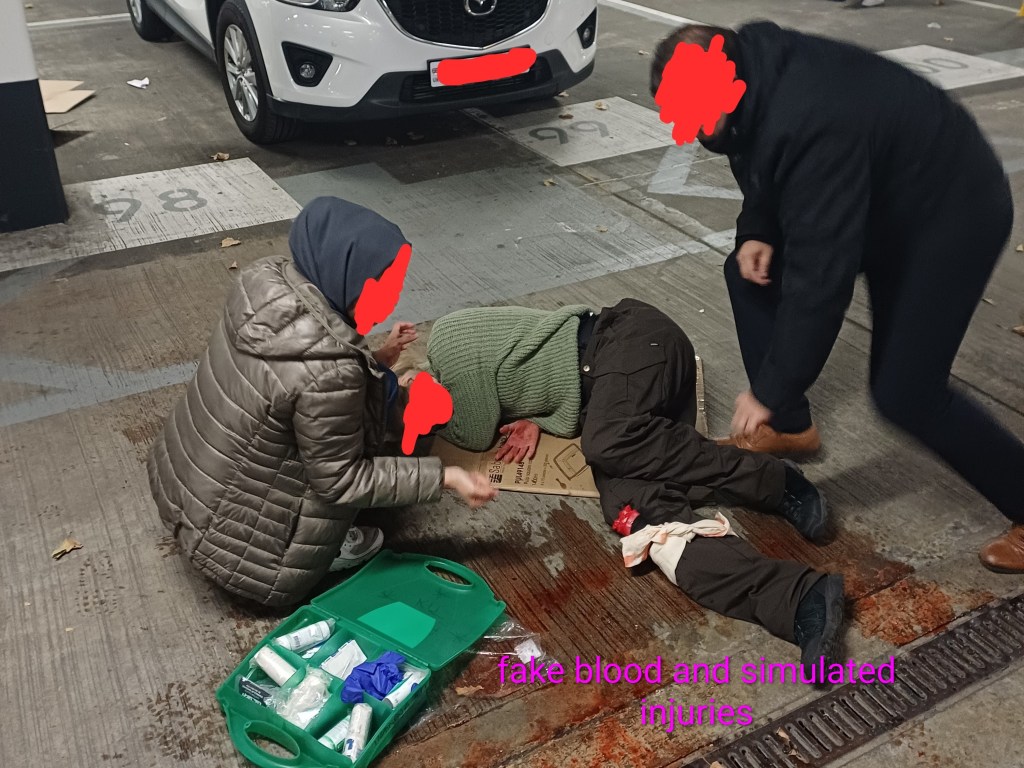
I recently took part in a simulated mass casualty event as a volunteer. All the following photos are fake and everyone is fine. But we were invited to make liberal use of fake blood, fake broken bones, and so on. We were set out in a scene in which the arriving first aiders were confronted with some people running at them demanding attention, plausibly when the right thing to do would be to ignore them and focus on priority casualties. The exercise controllers played deafening audio and volunteers like me were given instructions to act panicked, hysterical and unhelpful. The pressure and the excitement can be hugely overwhelming and people made mistakes, such as mistakenly kicking casualties (yes, really), getting ‘sucked in’ to helping someone who wasn’t the priority, and even ignoring danger to themselves such as a nearby smouldering car that was liable to set ablaze and explode.
I especially found my role in one simulation, ‘panicking person’, very interesting. I stumbled around screaming and yelling uncontrollably and the people designated as first aiders and responders didn’t know what to do with me. Certainly I made using the walkie talkie very difficult as I shouted ‘oh my god, oh my god’ as loudly as I could.
Dealing with these disorienting and upsetting situations is the kind of thing that you can train to be better at. As I’ve mentioned, first aid courses come with real simulated casualties, and you can even volunteer as a casualty with organisations to really practice these skills yourself. I’ve learned a huge amount from exercises like these even when I’m not the intended ‘trainee’ and recommend them enormously. Obviously not everyone has the time to start going to volunteer at more extreme scenarios like this, but even just practising scenarios where you enter a scene and treat someone feigning an injury they’ve sustained, maybe they’re entering shock and not being very helpful, can really help.
Wrapping up
I think that’s all I want to say in this post. In summary:
- Get first aid training. Emergency First Aid at Work courses, available from many providers, is a good baseline course for you to build your own learning on.
- Get a first aid kit that you’re realistically going to carry around where you go, especially for cycling. There is no point in owning a first aid kit that you’re not going to have access to in situations when you might need it. You might not be able to carry the kitchen sink but a little goes a long way.
- Be prepared to have to overcome your personal fight or flight tendencies, and potentially treat people who are uncooperative or confused. You could be in situations involving car crashes or just ‘slide outs’ on icy roads that seemingly came out of nowhere. Training and practice could give you the confidence and skills to overcome these reflexes.
Organisations of interest:
St John Ambulance is a charity who provide courses and equipment, as well as deploying trained voluntary first aiders to events such as football matches and music concerts. Read about their offering and browse their supply offerings here https://www.sja.org.uk/about-us/
If you’re a young person, or know young people aged 11-17, SJA also have a cadets programme which is well worth knowing exists.
Specifically concerning simulated casualties, the organisation Casualties Union provides such services voluntarily to organisations like London Ambulance Service and is worth learning about too. https://casualtiesunion.co.uk/
That about ends this post. Thanks for reading!
 Calum On Wheels
Great post on an important topic. Having just organised training for Sheffield CTC l would agree that the one day First Aid at Work course is a good place to start, but it doesn’t cover some important trauma injuries that can occur when riding; for example, concussion. Still, you don’t know what you don’t know until you get started.