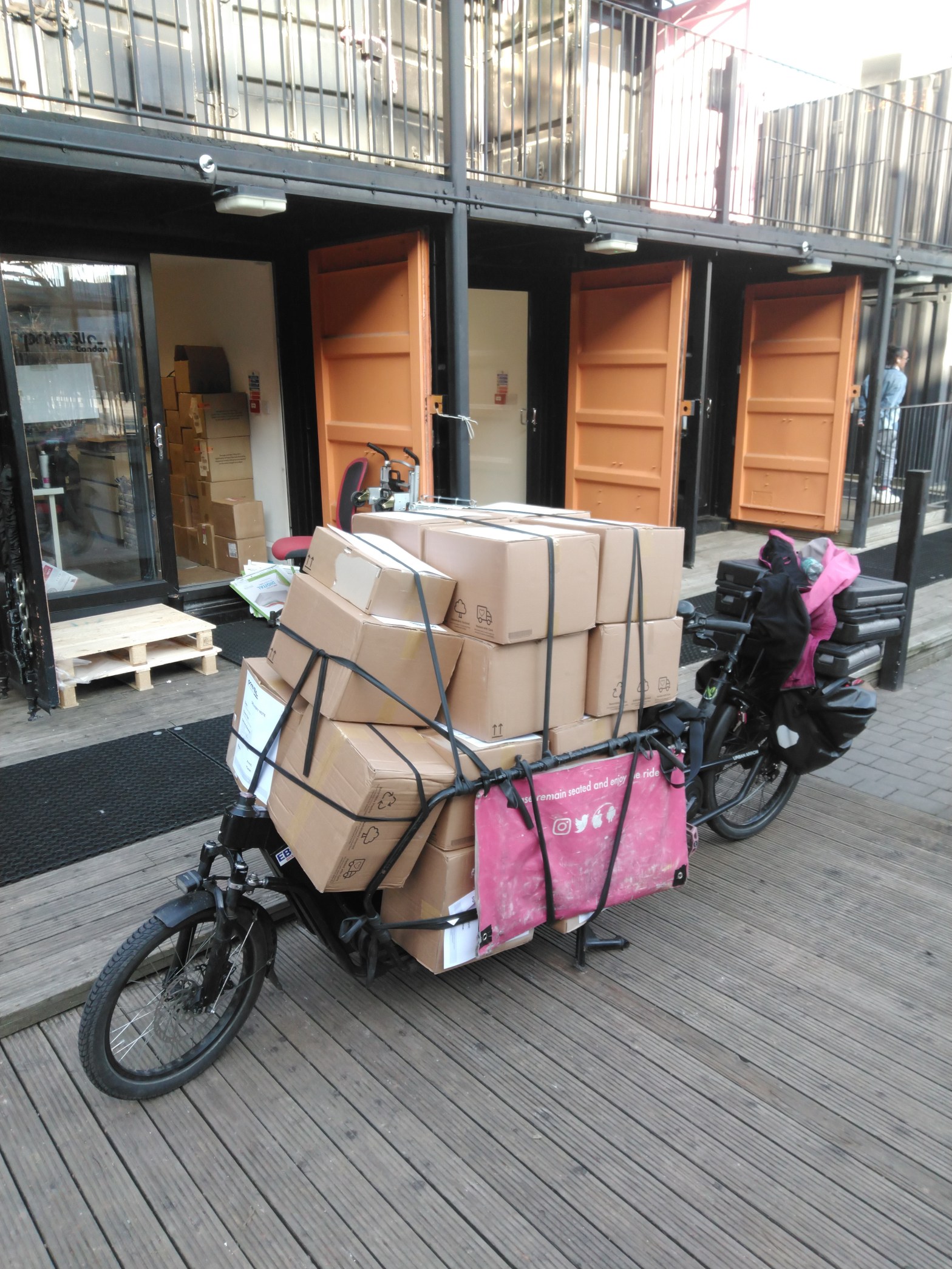
It was February 2022. Chris Whitty had just been knighted, the UK Prime Minister Boris Johnson had published an official statement about ‘how we will live with COVID,’ relaxing practically all the restrictions concerning meeting and travel, and I was cooked. I’d been working for the London Cycling Campaign for approximately two years, overwhelmingly indoors, and not really doing much cycling, and I was really not in a good way at all. My sleep cycle was all over the place and the only in-person communication I was getting was with a very occasional couple of laps of Regents Park with friends I really treasure. But this occasional relief wasn’t enough; I needed to go and figuratively touch grass. My chosen way of doing this was to quit my white collar job and become a cargo bike courier with an employer of cargo bike pilots. I did this for just over 2 years. This is a blog post about what I learned about Urban Arrow cargo bikes and how what I’ve learned might help you going forward.
Some of the photos are from a few years ago with quite a basic smartphone camera. Sorry!
Firstly, what’s an Urban Arrow XL?
An Urban Arrow XL is a cargo bike, specifically, while being a very large cargo-bearing cycle, it still only has two wheels, so it retains the manoeuvrability of one that carries just a person. It’s propelled like any bicycle, through cranks which actuate a rear wheel using a chain or belt, but the ones I was learning to use were abetted with a Bosch ebike system, which ‘tops up’ the cyclist with added electrical oomph, so long as it was working and you weren’t low on battery. If you buy one, you’ll probably need to add ‘coachwork’ on top which is usually a lockable aluminium box (not great when it’s windy), or a ‘flatbed’ which allows you to pack larger items and closer to the ground for balance, though can leave them vulnerable to rain and theft if the cycle has to be left unattended. Smaller ‘L’ models, along with some other smaller units are also available such as the ‘shorty.’ More on these later.
Before I forget to mention, there is also a UA ‘tender’ model which has two car-type wheels on the front, limiting its mobility, but potentially making it higher capacity and more stable in flat areas. I am personally minded to think anything that goes in one of these is a bit too heavy and scary for me, and I’d prefer to do multiple trips in an XL.
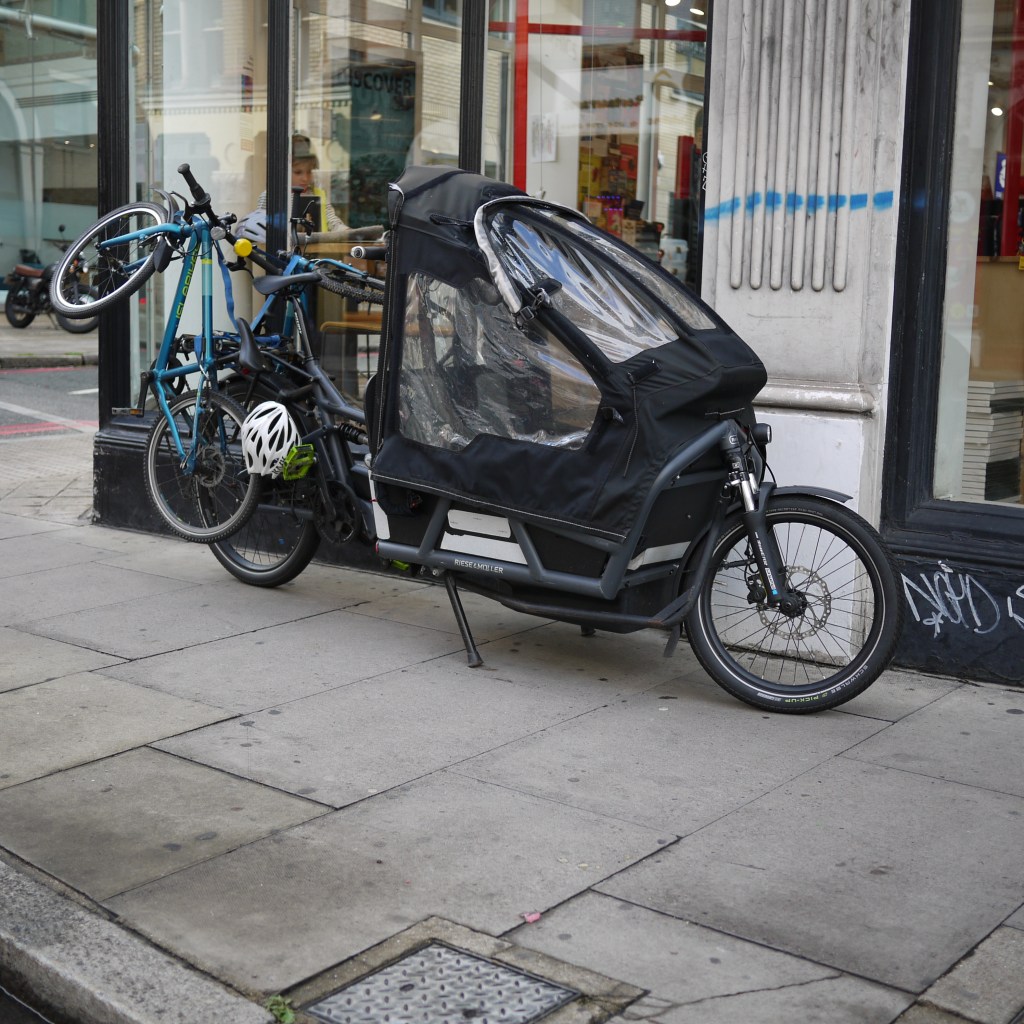
Urban Arrows XLs are predominant among e-cargo bike employers on the basis that they maximise the amount of cargo that can be carried, and in my then-employer’s case, they ostensibly enabled two passengers to go on the front. Other cargo bikes like the Riese & Muller models and Larry vs Harry Bullitt, or the Omnium, are around, but the Urban Arrow is currently on top for heavy and high volume movements. You’ll see them being used by the TFL Santander Cycle mechanics and Ocado Zoom crews.
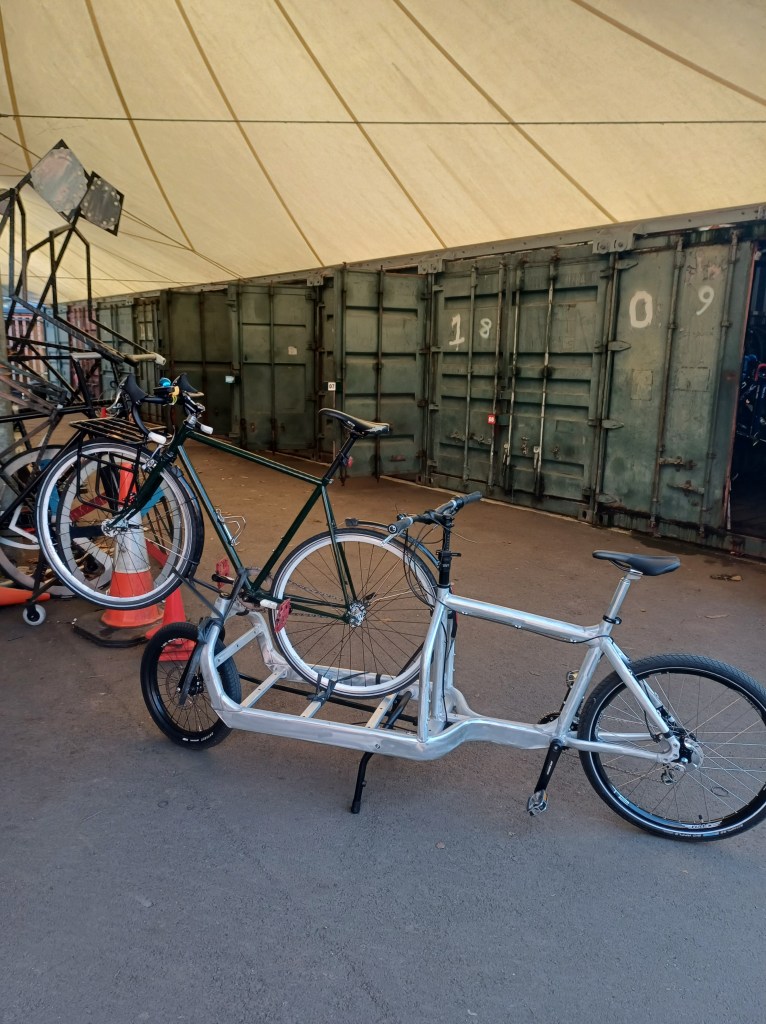
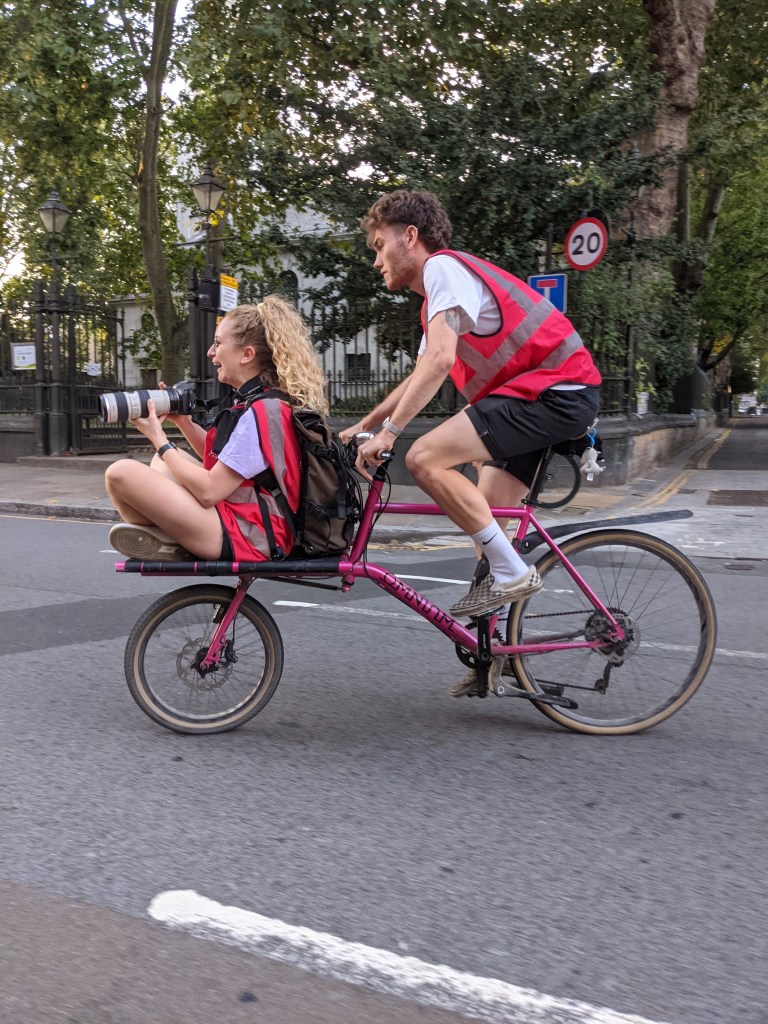
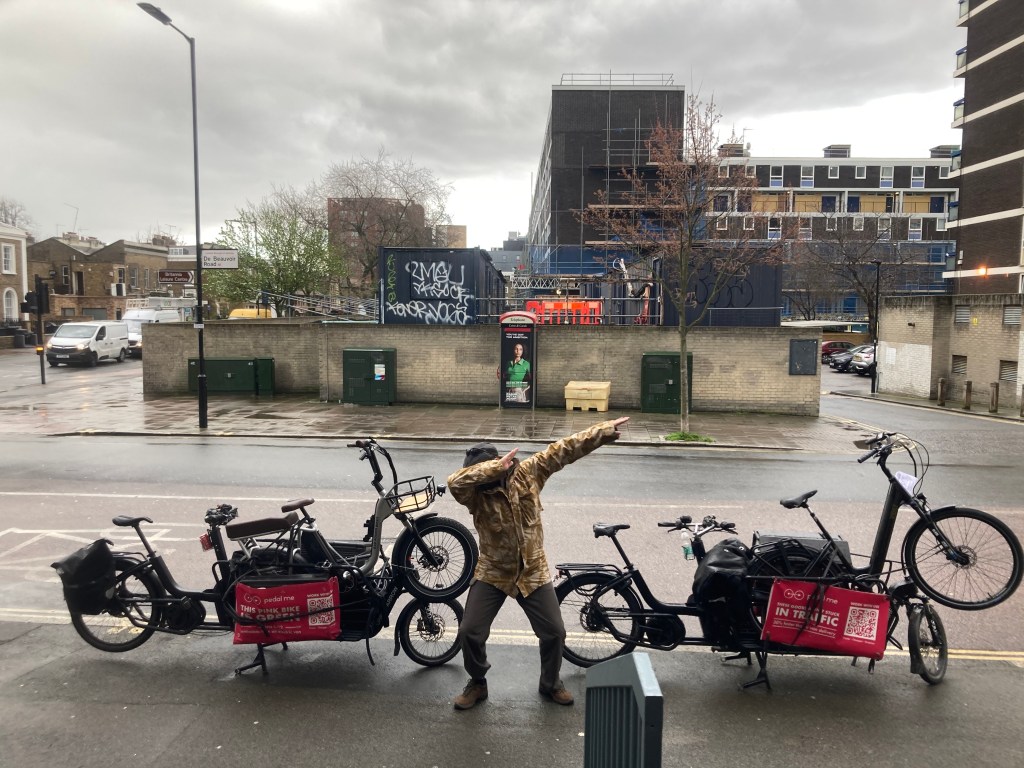
One thing Urban Arrows can also do is tow trailers. Now, towing a trailer isn’t unique to an Urban Arrow; so long as there is a suitable hitch, any bike can tow one. However, Urban Arrows are ideal for it, because they have a long and stable wheelbase compared to many other bikes. Trailers take some special precautions to use safely. Firstly, there is a big snaky thing behind you that can require careful routing through obstacles, and could be potentially hit by mistake. And lastly, the mechanism by which the trailer is joined to the cargo bike requires some careful use to ensure it stays operational without the trailer careening off and crashing into something. They are good machines, but require experience and expertise to use safely, so in my opinion, you shouldn’t consider them.
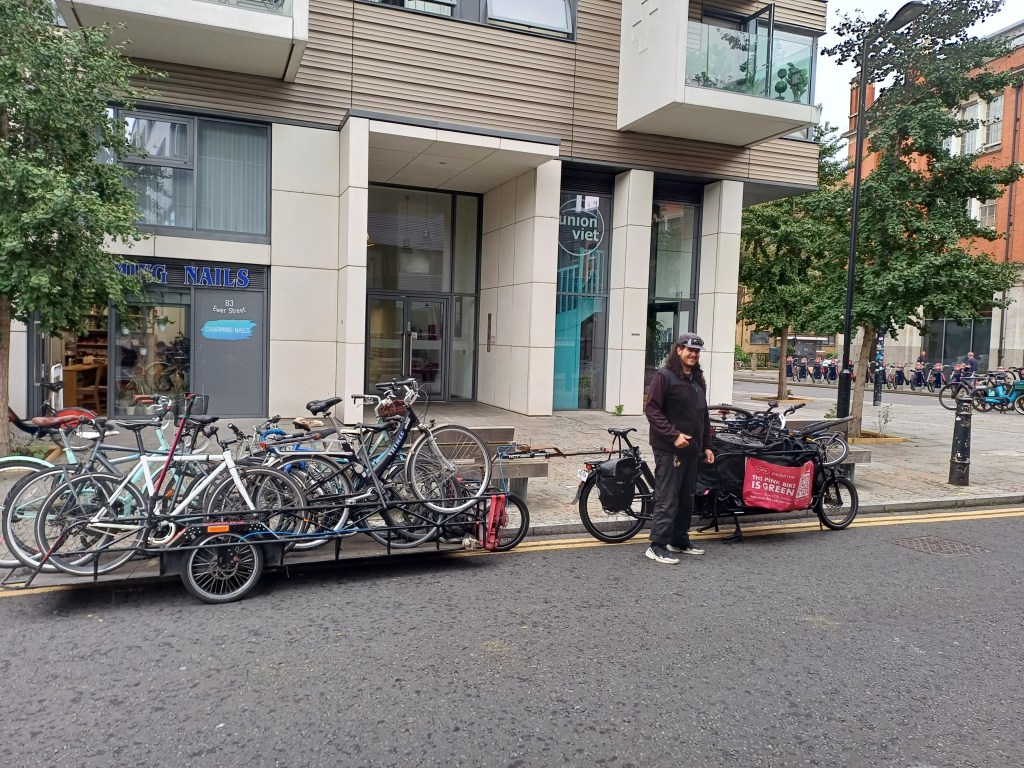
I’d actually paid other people to do ‘cargo duties’ with the Urban Arrows a few times before, including for work, which was how I’d known about my new employer as of 2022. I’d been a delivery rider with Deliveroo and Stuart before, so it wasn’t completely all news to me when I completed my training and started my first day at work. But there was lots I came to learn about these machines that I might help you with, which I’ll get into now.
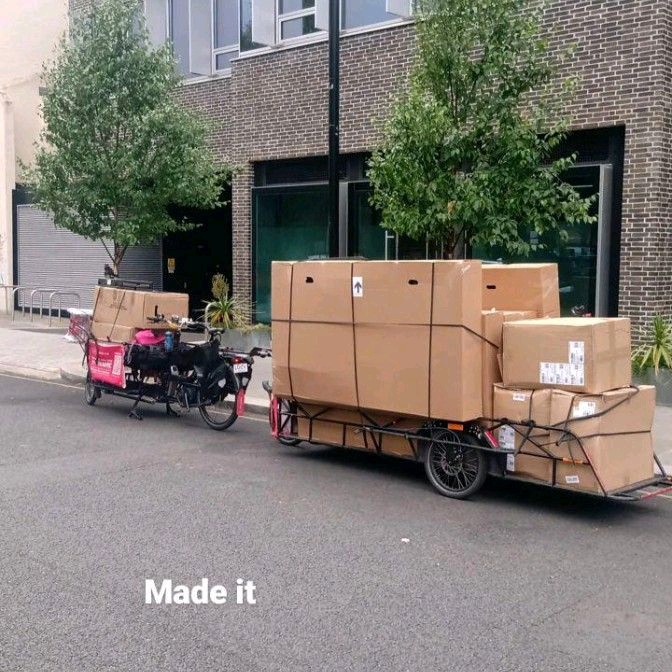
With the right training, an Urban Arrow really can replace a car*
I had a company car for 4 years (2014-2018) and not had a motor vehicle of my own since. I’ve very occasionally rented using Turo or Zipcar (soon to disappear from London), and that’s been it. I found that when I wanted to do moves, the Urban Arrow would pretty much cover it. For a flat move (eviction!), I did have to make repeat trips, but I did make it happen. The theoretical weight capacity of 150 kilogrammes, coupled with judicious use of old inner tubes as cargo straps, means you can go quite far.
Urban Arrows, helpfully, don’t come with so many of the bills associated with owning a motor vehicle. You don’t need to pay for parking or an MOT, they cost buttons to charge up inside, and while yes, they do retail for a few thousand pounds, you can buy them through Cycle-to-Work salary sacrifice schemes, which make them more attainable.
Urban Arrows come with the usual limitations that they leave you exposed to whatever the elements are doing. My answer to this is that the UK is, on the whole, quite a mild country, and it’s a great deal cheaper to buy the right clothes than it is to purchase and operate a car. So long as they’re working OK, they are a delight to pilot. And so long as you’re doing what most cars in London do, which is trips of a few kilometres carrying not-much-at-all, absolutely can replace a car.
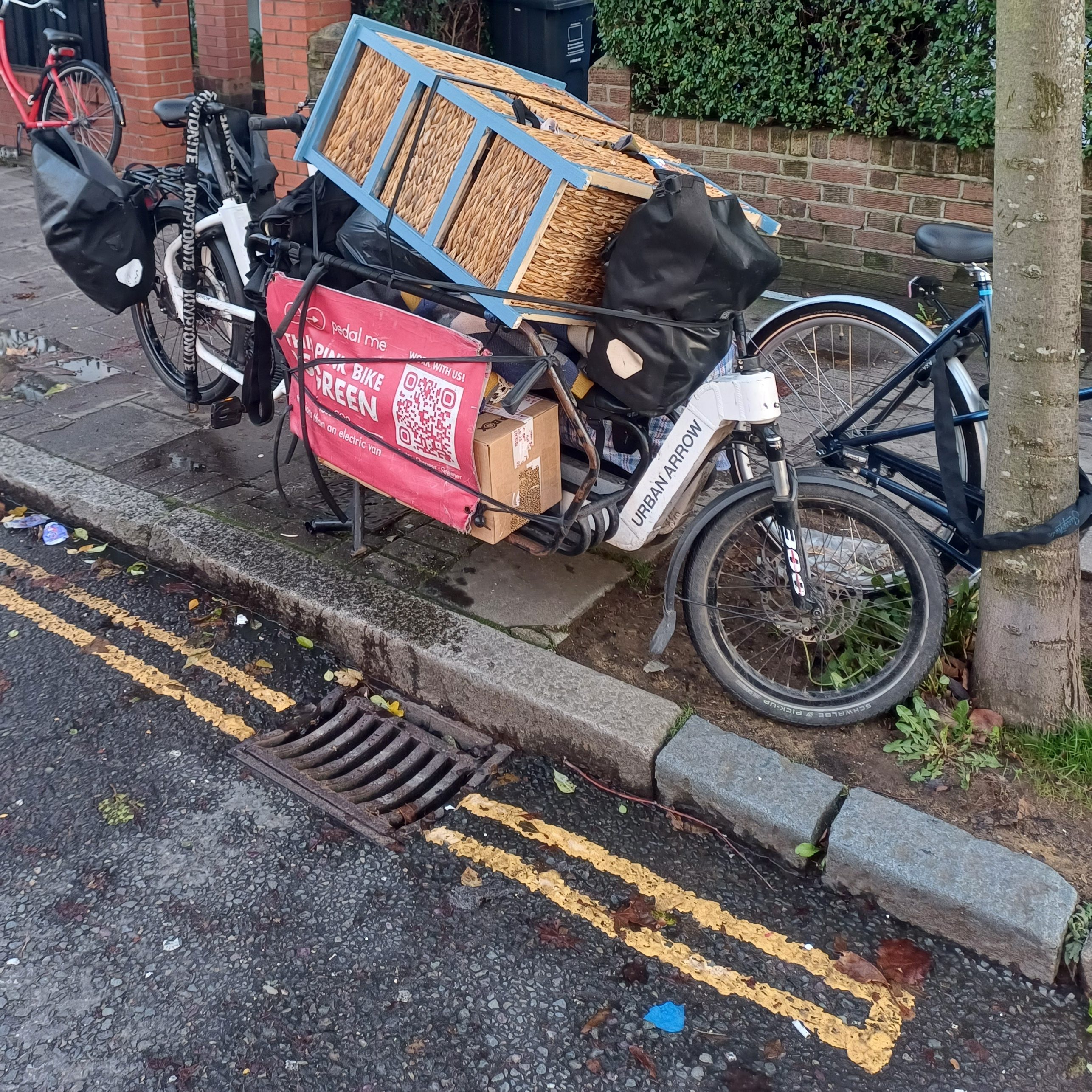
An Urban Arrow is really, really big and heavy and probably too much for you to keep at home
One distinct thing about Urban Arrows is that they are huge. If something like an Omnium or a Bullitt has some kind of breakdown, you can actually get them on to the London Overground or maybe an Uber XL so long as you provide fair warning. This isn’t the case with an Urban Arrow, which can’t even go on the London cable car between Stratford and Greenwich (I did try).
The significance of this is that an Urban Arrow won’t fit into a cycle shelter. It probably won’t even fit through most hallways. And long story short, this means it’s going to have to stay outside the home, which is a real risk. Cargo bikes require expensive components in terms of drivetrain (the systems which propel the bicycle) and especially brakes. Urban Arrows are typically retailed with a ‘Rohloff’ drive train, which is an expensive German internal gear hub on the rear wheel, but allows you to change to very low gears without cycling. In my experience, it is significantly easier to remove and re-fit a Rohloff rear wheel in the event of a puncture than a cheaper Envolio one and worth the cost.
Urban Arrows typically come with hydraulic disc brakes, usually by Shimano or Magura, which can be very easily removed from the bike using hex tools and some cable cutters to snip the hoses. A set of brakes plus the labour to install them will easily come to £200-250, which makes them a very tempting target for thieves. A rear wheel using an Envolio or Rohloff planetary gear hub will easily be around £1,200, including the special gear shifter. And of course, you have the Bosch ebike system itself, which commands significant value. The only real hope you have is that by removing the battery, it is less of a target for tea leaves, but there are no guarantees.
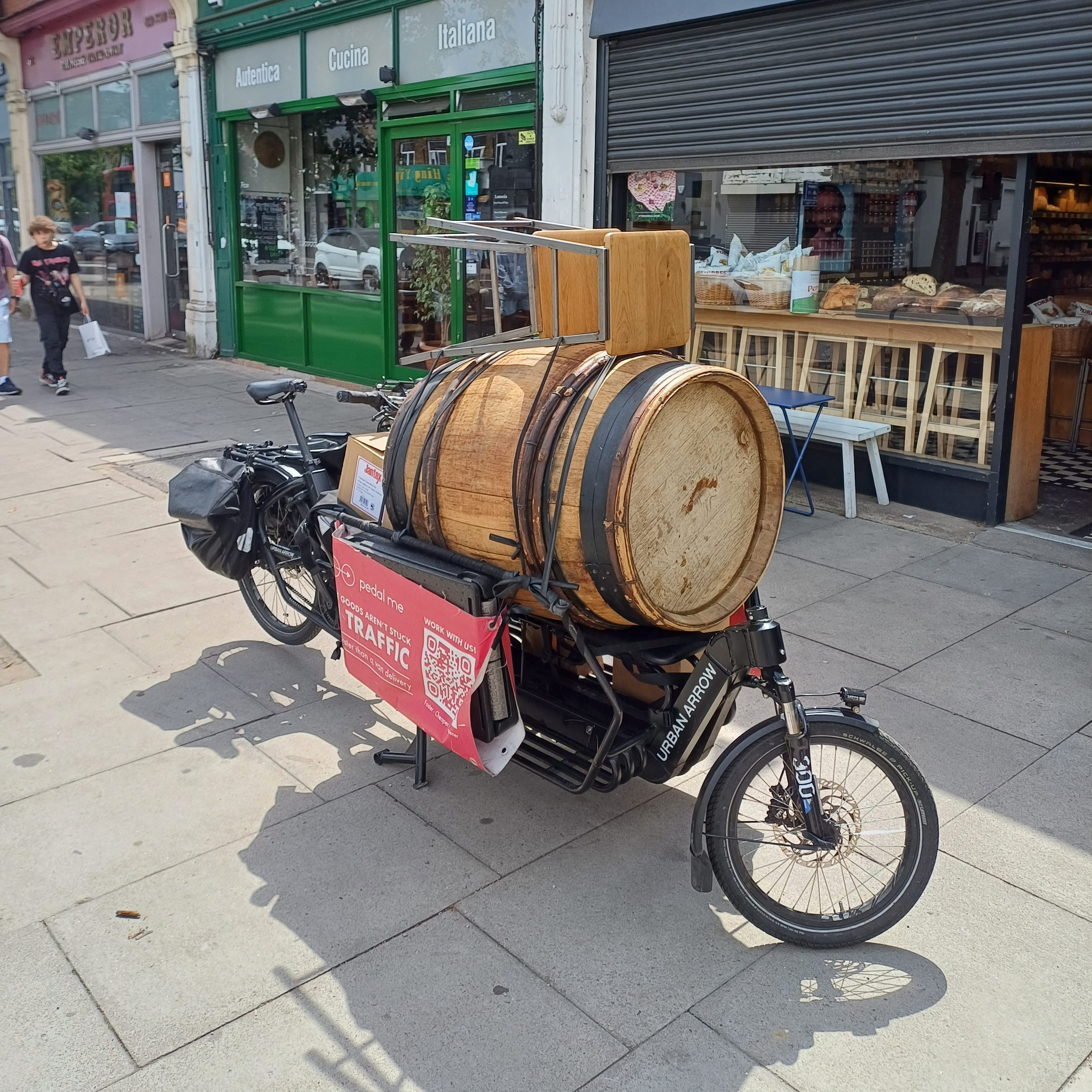
Thankfully, I never suffered any attempted theft or vandalism of the bikes in my care, but that certainly wasn’t the case for a lot of colleagues, so I don’t think I could ever own my own bike and be comfortable with it being outdoors. So that’s food for thought for you; there’s a reason why freelance couriers favour Bullitts or Omniums, which can be more easily brought indoors, often using a tilting front rack which enables the cycle to be wheeled through a home. This is something you’ll want to bear in mind if you’re mooting purchasing a cargo cycle, especially if you need to comply with the terms and conditions of an insurer.
Oh, and lastly, if you have some kind of emergency breakdown on the roadside, you are SOL with an Urban Arrow. I once was cycling from Finsbury Park to Newham for a job, and the bearings in the front hub completely disintegrated on me. Fortunately, I found a freelance mechanic who performed a service on my front hub, for which I couldn’t believe my luck. But there was no way the Urban Arrow could have been put inside a Taxi or even an Uber XL to go home. From my experience, they can only be moved with a very large trailer or a 2.8-ton van. This means you are actually dependent on quite a lot of mechanical nous compared to e.g. something like an Omnium or Tern GSD, which by comparison can be transported home in a taxi or on the train in an emergency.
Most freelance food delivery couriers are making do with lighter systems. Fundamentally, an Urban Arrow XL’s c. 150kg cargo capability is overkill for most cycle courier tasks of portaging food to places. Because of this, I should think that for most people, an Urban Arrow XL is probably more than you really need.

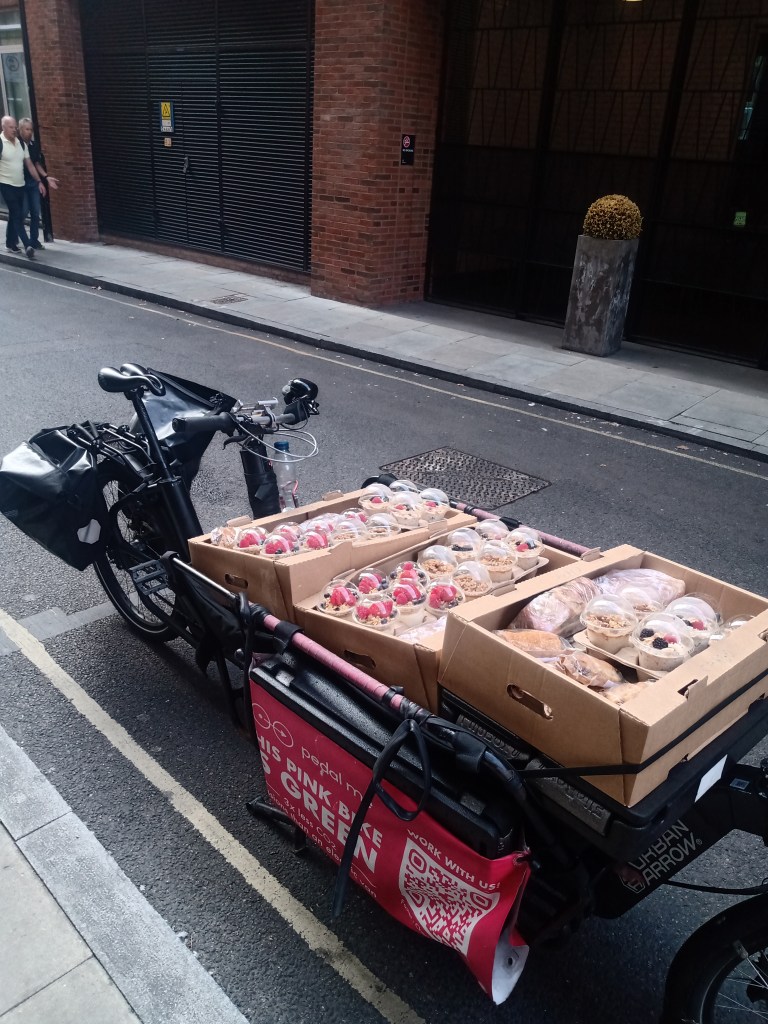
Rear wheel difficulties – beware, could be highly expensive
One big mechanical limitation Urban Arrows have is the rear wheel, which is what tanks the weight of the rider. At 26 inches in diameter, it is inherently less strong than the smaller 20 inch wheel on the front, so it acts as the bottleneck for the capacity of the bike more broadly. It is an unfortunate fact that if you internet search for ‘Urban Arrow rear wheel spokes,’ you are going to come up with reports of cracked rims and snapped spokes, and there is no real way around this. Some cargo bikes, such as the Tern GSD, get around this by having a smaller and stronger 20-inch rear wheel. The Reise & Muller models have a rear shock that helps dampen the aggro that the rear wheel sustains. But fundamentally, if you want to carry lots of stuff on London’s roads, there is going to be some war wounds, and with Urban Arrows, in my experience, this ends up being sustained by the back wheel.
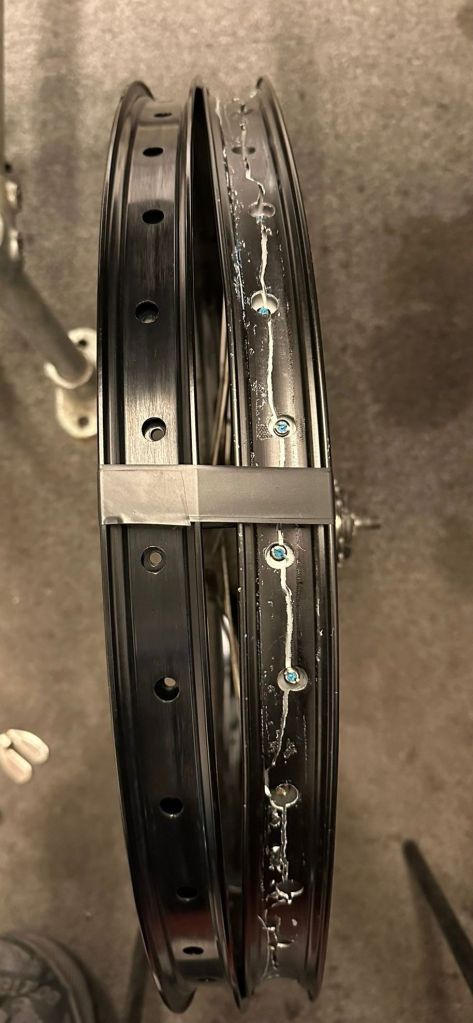
Rear wheel rebuilds are expensive. Once a back wheel has had a few snapped spokes, in my experience, this means the spokes are starting to ‘unzip,’ and once a wheel’s rim has started to bend and deform from even one spoke being damaged or wrongly tensioned, you’re on the road to a write-off. Even more terminal is damage to the rim itself. This can be seen externally in the form of small cracks around the eyelets for the spokes on the rim. Once a bicycle rim (usually made of aluminium alloy) has started to crack or bend, the thing is cooked. If you’ve ever bent an aluminium alloy soda can and then tried to ‘bend it back straight,’ you’ll see why metal fatigue is a killer. Broadly speaking, this is an expensive problem for which there isn’t a clear-cut way to avoid with Urban Arrows. Long story short, you should:
- Try to not carry too much, or be too heavy, or both. This is easier said than done especially if you need to carry a cargo pannier with a chain lock, mechanical spares and an extra battery
- Try not to ‘bounce’ the Urban Arrow up and down kerbs. Or, if you do, get off it first and ‘wheel’ it. Note your ebike motor should allow you to do ‘walk assist,’ i.e. the motor will help you push the cycle as you do so
- Pay for a rear wheel rebuild using the best rim you can find. This will require paying for a new rim, spokes, and labour, and it will probably take a shop at least a week, during which time your bike is out of action. Broadly speaking, the best rims are ‘welded’ aluminium rather than ‘pinned’ or ‘sleeved’, and the wider the internal width and the back tyre (ideally a Schwalbe Pickup), the better. You could try using a quality 26-inch carbon rim, which may be more resistant to bending and cracking than an aluminium rim, but I don’t truthfully know if this will work
- Don’t inflate the rear wheel’s inner tube too much. A highly-inflated inner tube will push the rim apart from the inside, and eventually can crack from within. This becomes a real problem because the rim can pinch the inner tube from the inside and cause a surprise puncture, which keeps happening repeatedly. Ask me how I know. And what’s the ‘right’ amount to inflate it to? Refer to the inflation guide on the side of the tyre, don’t exceed it
- Try to not take the bike off its kickstand with the rear ‘café’ lock still in use, which can rip out spokes and crack rims. Many Urban Arrow pilots have learned this the hard way
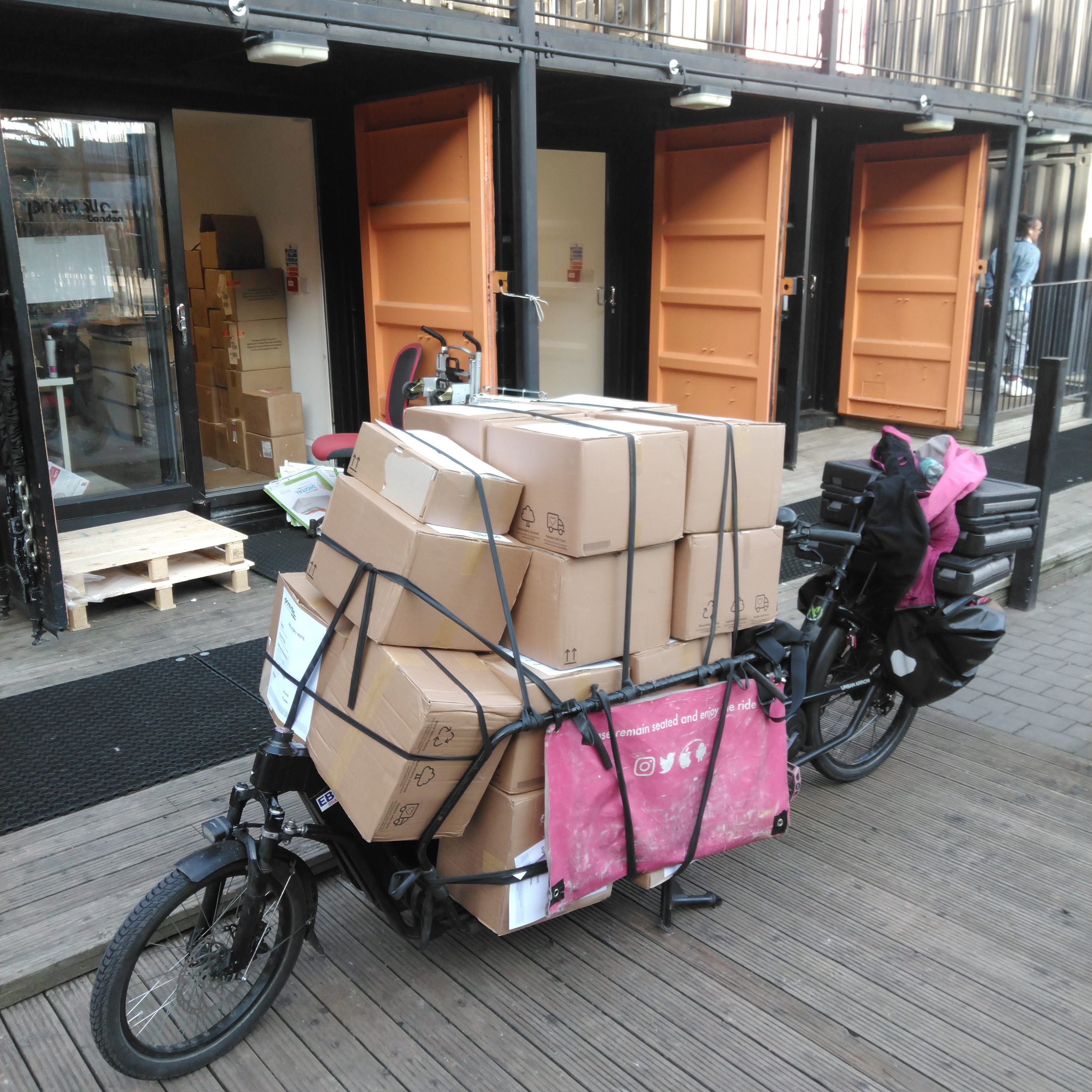
It might be a good idea to buy a second battery
An Urban Arrow XL can ostensibly do about 70 km in ‘range,’ but I would err on being more cautious, because, despite it being an ebike, it is still quite a lot of work to pilot. The human body will be working to keep the load balanced as you cycle, and if you’re using anything less than the ‘sport’ mode on the bicycle, you’re still contributing watts. And the more of the motor you use, the faster the consumption of the battery will be. Because of this, if you’re regularly doing 30-kilometre ‘goes’ in a day without stopping, or live somewhere hilly, I’d look into sourcing a second battery, or at least, carrying your charger so you can plug it in for another 30 minutes in a café if you need a boost. Finding yourself in the position of having to ride in eco mode, or worse, using eco to ‘start you off’ and then pedalling without the motor to ‘keep it going’ because you’re low on battery, is a recipe for a long day. The good news is the Bosch batteries should power the lights, which I would always keep running constantly, for the visibility of other road users if you end up inside a dark car park or tunnel, and forget to switch them on.
Bosch ebike batteries are expensive. When I last looked online in January 2026, they were £700 each. If you were buying a new ebike, it may be worth purchasing a spare battery as part of Cycle-to-Work to lessen the pain, and it should be slightly cheaper from a tax standpoint. You must also never leave an ebike battery unattended, because they can be crowbarred off the frame by a tea leaf in seconds and put straight on Facebook Marketplace for hundreds of pounds. Always, always take the battery off and take it with you if you’re parking your Urban Arrow (or any ebike) somewhere. Buying a battery from an unknown seller could result in you getting a fake battery, which has been ‘re-celled’ with ersatz internals such as dodgy 18650 lithium-ion cells, and could burst into flames without warning, all for a saving of a few hundred pounds, so you shouldn’t do it.
Ending and blog post conclusions
I’ve tried to stop this from becoming a ramble, so I will park this article up here. Long story short, think carefully before you invest in an electric cargo bike. They certainly can replace a car in a lot of cases, but they come with their own liabilities of safe storage space, costs of purchasing and maintenance, and require more skill to safely pilot than you might expect. My own recommendation to most people is to look at a Tern GSD, which has strong wheels for supporting the weight of a rider, can be brought inside, and can do a lot of the duties of a cargo bike without many of its downsides. If you can’t bring it indoors, you can fit an external steel security shed which it should fit inside for some peace of mind.
Personally, I’m making do without a cargo bike for the moment. I wear a rucksack that I fill up with bits from the supermarket and my bicycle has a ‘pizza rack’ I can bungee grocery bags on to. But maybe the day will come where I’ll source a GSD. Who knows. Thanks for reading.
Special thank you to Daniel Nagy for the cracked rim photo out of the personal ‘long day’ archive.
 Calum On Wheels