
August is dead quiet for my 9-5 job so I took Tuesday-Friday off this week (the week before August Bank Holiday 2025). I decided to ride some of the Cantii Way in Kent, which is a cheapish 90 minute train ticket away from London, so this is highly accessable without a car. I also had a Panasonic Lumix GF1 camera, which I hope will mark an improvement in the output on this blog. I should also add this is the first blog post following a trip done on my new bike, which is a titanium frame with bits and gubbins from the Merlin swapped on to it. This is a short article outlining what I learned and observed.
Oh, a quick note on photography. I am still very much in training. I only shoot in JPEG (I don’t have the gear or inclination to edit images in RAW at this point), but experiment with using the A (‘aperture’) mode as well as ‘auto’. As you’d expect images are copyrighted to me. If you want to use them for some reason, please email (see top of page).
Check the coastal wind forecast before picking your loop direction
The Cantii Way, being a round loop, can obviously be ridden around two ways. The default is clockwise. I usually try to always ride anti-clockwise, on the basis that left turns are preferable to right turns, since you aren’t crossing an incoming traffic lane, or needing to wait for it to be safe to cross (in the UK). This was contrary to the Cycling UK guidance, which directed me to ride clockwise on this loop. I decided to ignore this, starting from Ashford, and dipped south for the coast.
This was fine and great until I rode along the coast heading east, then turned up north once I’d gone past Dungeness power station. At this point, I was riding in to a northerly sea wind, which was not ideal. Looking this up, the wind direction can be quite changeable in south-east Kent, so if you can be flexible in your accommodation this could be a smart move.
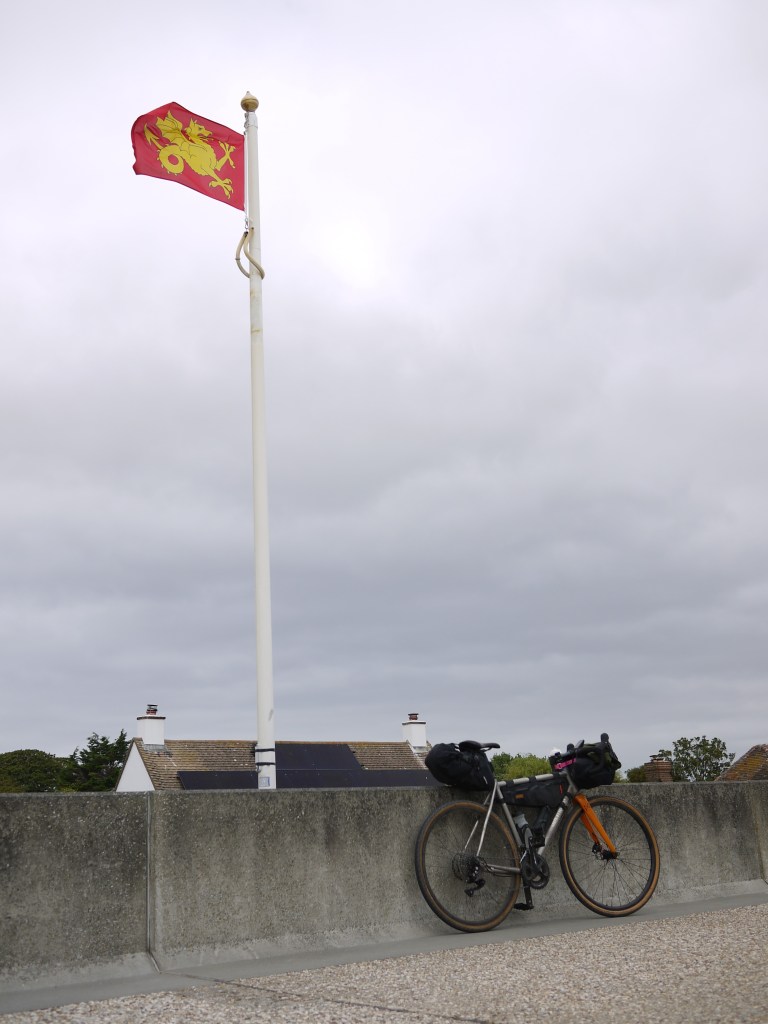
Truth be told, the wind really wasn’t so bad. I would guesstimate it was Beaufort scale 4 (‘moderate breeze’), so while it was certainly noticeable and the flags were flapping in my direction, I wasn’t grunting and heaving to make headway. If it was really bad there is a train line to Dungeness I could have bailed on with, but decided to just take my time and take it as a learning experience. Certainly, the people I met riding in the other direction had a laugh at my expense.


‘The Garden of England’ really blooms in August-September and is highly photogenic
I really enjoyed eating and photographing the fruit on the hedges on this route. At one point, taking photos of plums, one of them fell off the tree in to my hand, and it was delicious. I think prime harvest season might be a few weeks from now, so the blueberries were still too sour and hard, but the blackberries and raspberries were really scrummy. It makes a nice change to have soft fruit instead of just food scrounged from whatever convenience shop you happened past earlier.
You can’t rely on not bringing food with you – the hedgerows aren’t that abundant – but you could definitely do worse than bring a small punnet for foraging for later.
This is a good time to mention my camera. I returned the OM TG-6 from the previous post and swapped it for a Panasonic Lumix GF-1 with a four-thirds 20mm lens I bought second-hand from a forum. There is a lot to learn for me as doing anything more complex than getting my phone out is still very new. I may do a longer post about this in the future with more learnings.


The ‘gravel,’ at least in late August, is very mild and 35mm ‘all-round’ tyres were fine
The Cantii Way, at least the part I did, from Ashford to just south of Broadstairs, is predominantly paved. Because of this you really don’t want to be on 2 inch wide mud-moving mountain bike tyres if you don’t need to be. Thankfully, at least at this time of year, I thought my 35mm-wide Schwalbe All-Round tyres were the perfect compromise. They are sticky-out enough for what loose or slide-y surfaces there were without being horribly warbly and wide for the tarmac, which is on the whole, very smooth and comfortable.
The caveat here is that this is in late-August. If you were to do this in more like April and March, or even October, you may want to be more conservative and ride a bike that will make the off-road bits more safe and comfortable. Buyer beware. Riding off-road on unsuitable tyres is never good, and it’s worse when you factor in all the gear bouncing around on your bike and a sea breeze blowing about the place.
Speaking of gear, you might notice there is stuff on my bike. For sleeping, this time I had my bivvy bag, my Snugpak Travelpak 2 sleeping bag, my Snugpak thermal liner, and my Alpkit Cloudbase sleeping mat (with drybag inflater). I think I’m ready to upgrade my mat to something more voluminous. The Cloudbase does work and is certainly a huge improvement on a solid floor, which is hard and drains away all your heat, but I’m ready for something more comfortable. You do spend a third of your trip on it, after all. I didn’t actually end up using the bivvy bag this time, but it was reassuring to have it as an extra layer and since it can live on the outside of bags, wasn’t a huge obstruction.


The sea is very nice to look at and you have to be ruthless with camera time
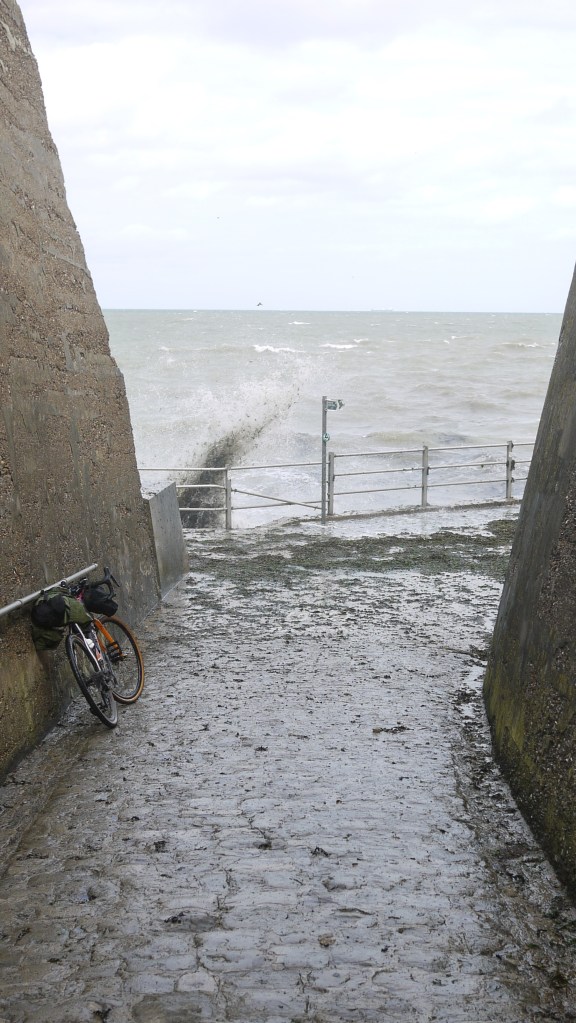
This is the first bike ride I’ve really done which is by the sea for most of it. I would guess about half or maybe two-thirds of the Cantii Way is on the coast, and that’s all of it that I did. Diverting to continue on the coast heading north, I cycled west from Margate on the ‘Viking Way’ (to London), firstly along the shoreline to Recluver, then inland to Canterbury, then following the ‘Crab and Winkle Way’ to Whitstable. I thought this was a great itinerary and it kept the sea in sight for most of the time. The good news was that once I started bearing west, I soon had the wind on my back, or at the least, no longer in my face.
I found that on this trip, getting the camera out was a real time sink. Firstly you see somewhere or something that looks good, so you stop. That’s 15 seconds. Then you lean your bike somewhere safe, that’s 10 or 15 seconds. Then you get the camera out from your bum bag and remove the lens and put it somewhere safe, that’s another 15. Then you mess around with angles and light and camera settings, taking photos, and then repeat the first three steps in reverse, and before you know it you’ve ‘burned’ 3 or 4 minutes doing photography. Add this up to a few times over the trip and that is quite the delay to the programme compared to just getting your phone out of your cargo bib pocket, if you even had to stop to do it at all.
Photography is a lot of fun but I’m going to have to ration how much of it I do to avoid spending too much time on it to the exclusion of the cycling. What I did learn is that morning and midday light is so much more preferable than I’d realised it could be. I found that by 4 pm the camera’s output just wasn’t much good compared to the morning’s, at least with the gear I had with me. You can see why the Cycling UK Cantii Way FAQ to the route advises three or four days; they need good photography for the relevant social media and documents.


The Battle of Britain memorial is neat and you should go
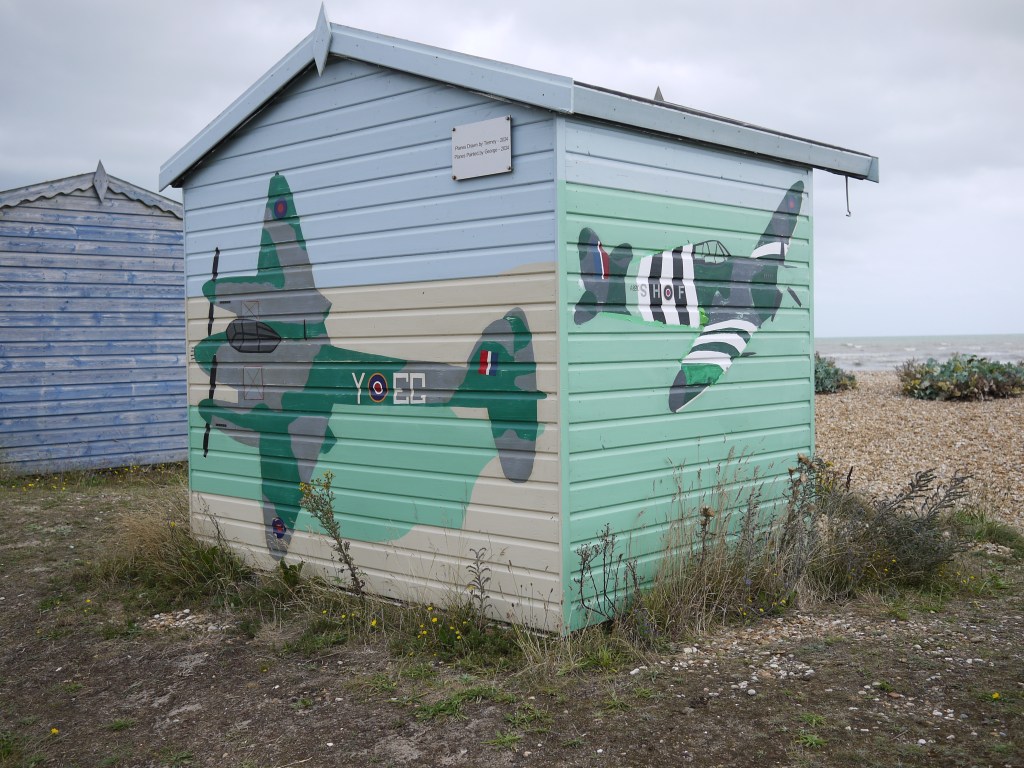
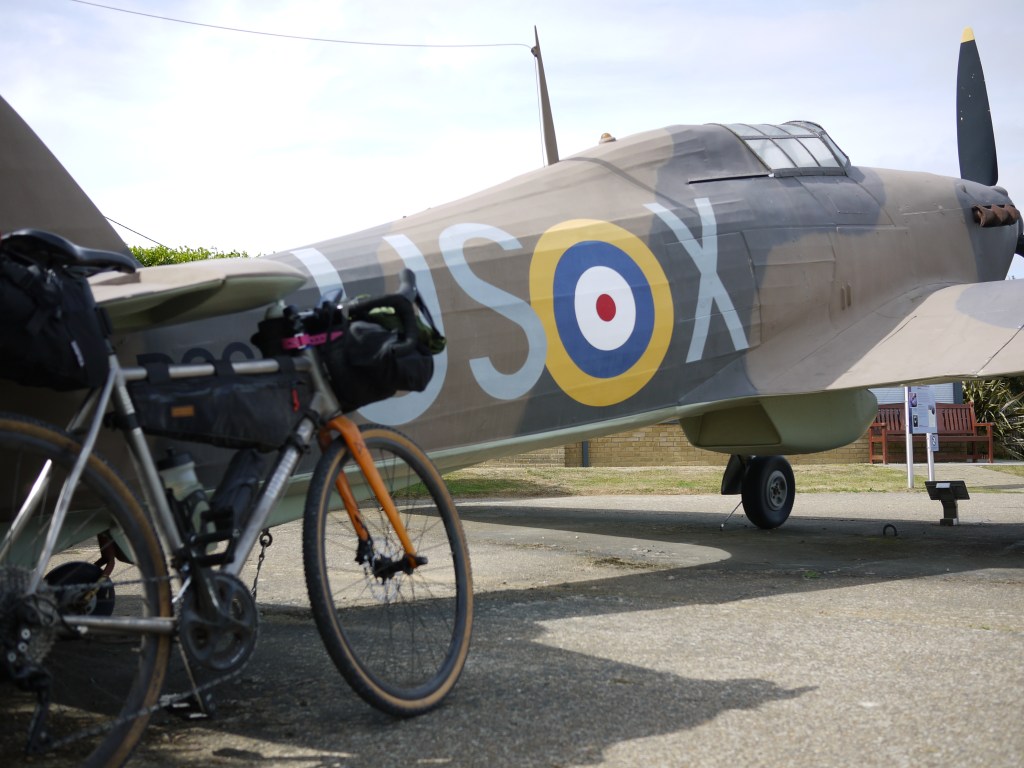
On the Cantii Way at Capel-le-Ferne is a memorial to the pilots and others who perished in the Battle of Britain, and there are replica planes beside it it is sobering to look at. Looking at the Hurricane, I noted the canopy was probably narrowed than my bike’s handlebars. Imagine trying to bail out of that while the plane is in some kind of spin or fire. Terrifying.
It’s a well-looked-after building and I can recommend the zucchini and lime cake to you heartily. Sadly you can’t take your bike inside with you. There is a ‘shed’ which the staff can see from their desks, so I took a chance and used my cable ‘cafe’ lock and it was still there when I was back.
Also cool are the various concrete structures that remain on the coast, including observation posts, pillboxes, and ‘acoustic mirrors’ which were the antecedents to RADAR. Simply put, the idea was you could use them to hear incoming formations from across the sea, especially during heavy cloud or at night.
I should note that the bits around Dover had the most challenging hills on this ride so far. As you might expect, the airfields tended to be high up and facing the wind; aircraft prefer to take up facing the wind so it blows over the wings, generating lift. I did consider doing this route fixed, which might have been ok for most of it, but I was very glad to have my 34-46 bottom gear ready and cranked my way up all of it.


Unfinished business in Canterbury, the start point of the Via Francigena, the pilgrimage route to Rome
Canterbury Cathedral, which is home to the English-speaking world’s oldest Christian place of worship, is where pilgrims begin the Via Francigena. This is a historic pilgrimage to the Eternal City, so about 1,800 kilometres or 1,120 miles all told. In the late 9th century, St Sigeric, the then-Archbiship of Canterbury, walked this route to receive his ‘Pallium,’ a woolen cloak that signified his authority coming from the Pope.
I have a long-term interest in cycling this route. One of the draws is that you can use a ‘Pilgrim’s Passport’ to sleep in churchyards. I dropped in to the Cathedral and asked one of the guides, who excitedly summoned the Pilgrim Officer, who talked to me all about it. Apparently, it is hugely difficult to do this conventionally-walked pilgrimage in the 90-day limit that UK passport owners are now bound to as tourists, necessitating a ‘Schengen shuffle’ as he put it.
All I have to say at this point is ‘watch this space.’ We had a great talk together. They were quite disappointed I wasn’t starting the pilgrimage there and then. There is a ‘mini pilgrimage’ called the Augustine Camino in the UK I was interested to learn about, but it’s on walking footpaths only, so not really for me. There was some other cool stuff around the Cathedral, like this memorial to horses killed in war, and these ‘insect hotels’ around the grounds to give a warm and safe home to pollinators. This is a good time to note that Kent has historically been a wealthy constituency for landowners, which includes the Archbishop of Canterbury, on account of the high-quality soil which has provided wonderful fruit, veg, wine (yes, really), spirits and beer for many centuries, not to mention wool which was England’s principal export until industries fuelled by colonialism supplanted it in importance.


Ending, thank you’s and wrap up
I have some special thank-you’s to make to end this. Firstly to my pal Roo who did an amazing job replacing the busted zip on my Alpkit bum bag with a purple YKK one. This really means the most because it’s a sentimental item and I love having it on me. Roo is one of the head honchos at Queers on Wheels which you can read about here https://www.heylo.com/g/-N4JZ6VUF5uSOLO9zX_T

Secondly to my friend Pavlucha, who gave me his old camera bag which is a great fit for the Lumix. You can visit his website here https://dogspotting.substack.com/
I really do want to check the rest of the Cantii Way out. I think on the bits that I missed, there is more history with regard to iron age Britain, specifically concerning the Cantii people who it’s named in honour of. Read more about it (including getting the route) at the Cycling UK website page https://www.cyclinguk.org/routes/long-distance/cantii-way
For more info about my sleep system, specifically the bivvy bag, see my previous post https://calumonwheels.com/2024/08/15/bikepacking-army-goretex-bivvy/
 Calum On Wheels